Links associated with Baptist Medical Centre, Nalerigu
Wednesday, January 30, 2008
Empty Spaces
Friday, January 25, 2008
Hot Water
Hot Water: a simple concept of course, you take cold water and apply heat.
The baby was premature at birth 2 weeks ago but had grown and the midwives discharged the infant last Sunday weighing about 5lbs 6 oz with instructions to come back to the hospital (a walking distance away) if anything should happen. By the time “something had happened” on the morning on Wednesday and the parents had worked their way through the long lines and had been seen by a medical assistant and had been identified, had worked through the lab and had gotten to the ward, it was 5PM and we were at the door to leave.
He was small frail, cold, blue and gasping. His heart rate was fast and thready. I examined him and as well as I could tell, he had no pneumonia, abdominal catastrophe, trauma or “localizing sign.” He was just dying. Back home we would probably talk roundly of “late neonatal bacterial sepsis” would get labs as appropriate, would start an aggressive course of fluids, pressors, mechanical ventilators, steroids and antibiotics. He would be tubed and “lined” monitored and measured.
What we had was IV fluids, low flow oxygen and precious little faith. A spinal tap was done quickly, once the IV was “set,” antibiotics were given and I set about to see if we could reverse the inevitable. We pushed in saline to open up his collapsing blood supply but within minutes his faint breathing stopped and his heart rate fell to the sixties.
“We lost him.”
Despite all though, his gasping respirations continued and his heart rate lingered below a hundred. I was discouraged and fascinated; it is a peculiar thing that when an infant is dying, the heart continues to beat faithfully long after death is assured, long after all measures are made and failed and long after the staff are too discouraged and exhausted to notice. Even brief tortured breaths can be noted. So was it here. I gave orders to be called when he died and left at 8PM for a cold dinner of rice and beans. I circled around afterwards to talk with the staff and said how I had appreciated how they worked with the “baby who died.”
“Oh he is not dead yet.”
Humility is not a condition I cultivate but would learn something of it then.
He was still cold and pale but breathing easily with a good heart rate.
He still looked dead to me.
What more was there to do for my embarrassing patient?
“When all else fails, start at the beginning,” I was told once.
Vitals signs were ok now but this temperature? A quick check for the record; his temperature was 32.6C (about 92F); hardly above the room temperature. How were we to warm him? There is no incubator for him; no electronic gismo to make sure the temperature stays even. On the wards there is not even running water. The hospital has hot water, for washing surgical equipment, IV bottles and such, and it closes at night as does the lab.
He needed hot water bottles; a remedy of which my mother would have greatly approved. The pharmacy was at least a place to start. I called to the newly arrived volunteer, Chuck Holmes, and we started to conspire. Half-quart glass IV bottles would be water-proof with no leaking onto the bed, easily transported in cardboard boxes and insulated therein to boot. I acquired my first half-dozen bottles, filled three with hot tap water rather than the scalding distilled water from the still and carted over to paediatics the first batch. We tucked them into folds in the thin cotton “kanga” cloths which serve as bassinet, clothes and diaper for newborns; one on either side and one at the head (heat loss is largely from the head). He still looked dead and it took an exam to prove to me he was breathing and had a heart rate. I circled around, collected my next half-dozen bottles and headed back to “House 6” about a quarter mile away, with a mission.
Hot water in most African mission stations and indeed in most places I have stayed is provided by a “geyser” (pronounced “geezer” at least in central and east
Again surprisingly, our “Lazarus” gained temperature with each hour reaching normal in about 5 hours. Maintaining his temperature during our current hamartan (dust storm) was tricky, all the Ghanaians are complaining bitterly of the cold night weather, going down as it does to the hi 50’s in unheated mud wattle houses. Nevertheless, Lazarus was warm yawning and active by morning. We could even stop the bottles by this evening, as he was well enough to cuddle with mother instead.
We have just started trying to re-feed him by tube now; I have no idea whether it will be successful and what ever damage he might have sustained. I do know that anyone who says that serving is rural
Wednesday, January 23, 2008
Cleft Lip Repair
Cleft Lip Repair
Quiet in a lime green room with piles of instruments wrapped in clean discolored and bleached out packages, stacked in a corner. A tape-player doing Bob Marley covers. A small child naked in the middle of the room on a table, an IV trailing from a small arm. He is apprehensive, wide-eyed and absolutely quiet.
His face is marred by a cleft lip, exposing his teeth and gums. Dr George Faile, almost equally quiet, takes a “before” photo and proceeds to consider his patient. Gentle hands move lip and tissue to imitate his thoughts. Hands cup about an anxious young face, straightening it for the trial. Measurements are made and re-made; after minutes, a pen is produced and the thoughts are committed to ink on skin; hands return to move tissue to what will become new reality. A final check and a small injection into the IV. Lids flutter and close.
A small face is draped with towels; gauze is inserted into the mouth to prevent blood finding a windpipe while the boy sleeps. Suction apparatus is rigged, short quiet sentences and all is ready.
A prayer to the creator God; a request for guidance, mercy and healing for the boy.
Bright red blood against black-skin, white teeth and yellow rubber glove. Hands dance in attendance over the small field of a boy’s face. Decisive cuts, bleeding erupts and is subdued with heat and smoke. The smell of burnt flesh is part of the ritual of healing. Flesh is again measured, approximated and for the moment left open, a wide red gash in a young face. The cycle of drawing together the flesh begins. Parts long separated are reunited, flesh deficient is augmented by design; odd pattern is revealed as a fitting together of puzzles into a new declaration of wholeness. The red gash narrows; tissue layers are arranged and straightened. Finally the now thin red wound is closed by blue sutures against the black skin of the boy. A final suture is cut. He does not awake as yet but his face is whole.
Tuesday, January 22, 2008
Update
I continue to improve and today received a "care-package" of medications from Cindy Shumpert "just in the nick of time." I also had the pleasure of meeting Doug Johnson, UAB School of Med. MSIV, who came with Paul Shumpert MD, arrived today at Nalerigu. Today is a day of arrivals and tomorrow of departures, a Bud Young MD, Megan ( med/peds resident) and Tomas (an Argentinian) all leave for Tamale and Accre in the afternoon.
We had a bit of an outing today, going up to the escarpment with the new arrivals, a walk and a climb through this dry land, to a cliff face overseeing the dusty river bed with a thin line of verdant at the bottom.
Tomorrow I am scheduled to see all the nutrition patients. Joanna, the nutrition nurse and I are actively plotting how we will improve things while I am here. Over the weekend, we lost another baby; probably due to gastric rupture from prolonged labor. There is much to do.
BTW, some ppeople were having problems leaving comments. This should be solved as of now.
Sunday, January 20, 2008
Work Permit
Let me first thank you all for your prayers and our God for his mercies. I am not well but I am better. I work from one treatment to the next and sleep well.
Choirs perform with gusto and volume; music provided by an over worked sound-system, an indifferently tuned piano, a drum set, tambourines, and an electric organ. The wind is blowing up another “hamartan” and the fans overhead are not running. Children wander in an out, are tracked-down, captured and kept hostage or escorted out by mothers, older sisters or “aunts,” babies asleep on their mothers’ backs, oblivious to the commotion.
Offerings are provided for with a whole church “march” for want of a better name. Everyone comes to the front to deposit their gifts in a box. However, the joy expressed is nothing regimented. Grandmas shuffle along shooing children from under un-steady feet, girls dance up and back, hardly touching down; matrons demonstrate dance steps I would have coveted in a previous life. All is joy and hub-bub. The service is in English and Mampuli, the local language. The sermon was on “building good relationships” Romans 12: 9-21. It was a nine-point sermon, in English; I saw many people taking notes.
I was the only volunteer attending; there were three gun-shot wounds, 3 stat cesareans (one mother who coded on the table), an acute abdomen laparotomy over-night and a morning of ultra-sounds to do. Everyone had slept in, woken, rushed out and was already back at work when I was collected. And I have a work-permit starting tomorrow.
Saturday, January 19, 2008
Update
I am better, I think. The fever is down, the cough is much better and I can sleep for hours.
I am still under immediate threat of being kicked out unless I get a LOT better by tomorrow so....don't stop.
Friday, January 18, 2008
Now is the time
Since arrival I have not been doing well medically. I started coughing more overnight and the treatments I was taking were ineffective for more than a handful of minutes. Given the high local concentration of medical students, medical residents, internists and surgeons, it seemed possible to get some advice. I was advised to start a potent steroid intravenously (I was already taking one by mouth). This is a new high (low?)-water mark for my asthma. After a number of attempts to keep an IV in, we seem to be successful as of Friday morning.
The reason for this deterioration appears to be a small pneumonia as I woke up with signs and symptoms thereof (I will spare you the details). The coughing is so paroxysmal and frequent that I am pretty much in constant
abdominal pain. On consultation with George Faile M.D. he has given me antibiotics, continued the steroids, put me at rest at the bunkhouse and 48 hours to get my act together; if I persist in my transgressions I will go home.
Dear friends, visitors and family. I would covet your prayers for my healing, recovery and alleviation of pain. More to the point, I ask that you pray for my faithfulness at this time, my patience (never in great supply) and a witness be derived from these circumstances.
That having been said and the substance of things hoped for communicated to you, I will go on to other matters. The pediatric patients are divided into several groups: the acutely ill, the malnourished, the isolated and the newborns. The acutely ill are a hodge-podge of surgical and medical patients; mostly with malaria, burns, fractures, pneumonias, and parasites. The malnourished are handled by a feeding station run by Joanna, a medical assistant (nurse with additional training). It is one of my goals to become a best buddy and indispensible to this good soul before I leave. Just in passing I found a 11 month old who has not gained weight in 7 months. Mom is still breast-feeding; very curious and I have my concerns. I had difficulty pushing together enough baby to fit under my tiniest stethoscope in order to listen to his lungs. The newborns are also mostly relegated to mid-wife care as patients are admitted and discharged dead without much input from a doc. We shall see. The isolation ward is generally more airy but fetid with the smell of open wounds and phenol antiseptic. There we find tropical ulcers, Burulli ulcers (a particular nasty requiring wide excision to heal) and TB.
Please keep ALL the patients at
Thursday, January 17, 2008
Arrival and Departure
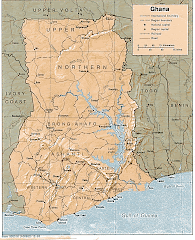
Tamale (TAM-a-lay) is hot, dust-blown and extensive. I had been warned that the party meeting me would be doing errands before bringing me to Nalerigu and indeed it was so. Everyone should take advantage of being an inconvenient supercargo at times. It is good for one’s humility and improves the accuracy of one’s self-image immensely. I was the inconvenient fact that disrupted three hospital workers with more important things to do. I was met by Chreesy, Issa and James. The latter two spoke with me not at all and all three spoke around me for the hours it took to arrive.
For efficiency sake therefore, I was dropped off at a gas-station restaurant. As I had missed breakfast, I decided to make a lunch memorably with my first Ghanaian meal. I ordered banko and tilapia (I got redfish, “This Is Africa”). Banko is a thick pudding made from taro-root and is the local replacement for bread and potatoes. It is grey slightly translucent and mucinous, served as a great piping-hot cow-paddy on the plate. As is the usual custom, hands are washed at the table in water before and water and soap (this time dish-washing liquid) afterwards. The taste of banko is bland, something like potatoes or grits and quite satisfying especially with several sauces available. The fish was deep-fried and too hot to dismember immediately. I ate, enjoyed and had a surfeit. (USD 4.5 with coffee, water and a tip) Lunch was a leisurely affair. I washed up and waited the 2 hours before I was collected listening to African rap, drinking water and reading.
There were several more stops. Chreesy unnecessarily informed me that we had stopped at the “meat market.” It was a small off-road plaza surrounded by tables of dismembered cow parts and a stand of several wide-eyed young veals awaiting an early retirement or a mother-less adolescence. After several more stops and a quick trip to an open–air, waterless loo which needed no advertisement (other than odor), we were finally off to Nalerigu (na-LERI-gu).
Northern Ghana is dry this time of year and I watched dust-devils form over a sear landscape. The road was paved and we barreled along at over 80 mph at times. Passing was a much more relaxed affair as it could be done on blind curves and on hills, dodging bikes, goats, children and pot-holes. Despite all, we gradually rose above the dusty plain to a ridge of truly Africa perspective, red-brown sandstone carved by the rains and the winds into vast rounded blocks with steep-sided gulches filled with green water.
The land became increasingly verdant as did the diversity. Arabic script beside neat mud mosques with pigs running stiff-legged away from our noise and dust. Large schools with there students blossoms of intense color in their uniforms walking and biking from the halls of learning. A long-haul truck, taking a curve too fast, appears to be reclining for at least one more rainy season yet. A man in a burnoose, it billiowing out behind his motorcycles like a small tan sail. Men endlessly pushing hand carts filled with mountains of produce. Donkey carts kept at a jolting trot by small boys with thick sticks and a mean streak. More stops to find a favorite vendor or drop off a purchase of taro root. Finally a truly remarkable sight, a small pond, a reservoir for East Mamprusi district, Nalerigu and the site of Baptist Medical Center.
We were let into the compound by the gate-guard in front of the hospital built in 1957 by George Faile II, father of one of the current doctors. I was deposited at number 6, the “bunkhouse” shown a double room with sparce furniture on a tile floor and left to recuperate. It is an African room. High ceiling, two huge fans, with a single florescent tube, two low single beds, a wardrobe of beautiful wood with a sturdy lock warped so that the door doesn’t close, and a set of drawers for the two occupants the size of a bed stand. I note as I enter, that 14 hours of no therapy has made my breathing audible even to the house workers. I am out of breath walking to the room. I treat myself and spend the afternoon coughing and using a nebulizer. I may not be better after all. The air is dry and I am having diffilculty keeping hydrated.
By 5PM I was hulloed by Burt Young a 79 year-old “retired” OB-GYN from Murphysboro, TN who undertook to show me around. We have a truck at out disposal and use it to haul the equipment and meds given me to deliver. As we emerged from the truck we were met by some of Burt’s “boys,” youngsters of 8-12 who have chosen to become Burt’s shadows, general factotums and go-fers on the expectation that they may get a tip and (as I said) they knew a sucker when they saw one. I was hit up for a tip and when I declined was asked if I had brought any books, “so we may read them.”
Burt and I wrestle the duffel to the pharmacy to deposit the meds and then to the surgery suite to drop off the suction equipment. Our shadow, Elisah, is only too happy to put the duffel back into the truck for us as I got a short tout of BMC. Burt naturally started in the women’s ward and we took a detour through post-partum to look at a lady he had delivered of a still-born. As I passed the nurses’ station I noted that an elderly (and inoperative) incubator is occupied. As usual no one was notified when a 3 lb baby was brought in that morning. She is purple with an occasional breath. I quickly listen to her heart rate; it is agonizingly slow. Nevertheless she is warm, and when I give here a few breaths here heart rate climbs and she starts to breath on her own again. Burt comments that I am trying the impossible and I admit it. I talk with the nurse-midwife and try to make a plan. Any intravenous therapy is out of the question as maintaining it would be impossible. I write for some fluid and base through a stomach tube and a respiratory stimulant.
We returned to the bunkhouse and met our roomies, Tomas (an Argentinean medical resident), Megan (a 2nd year Med-Ped resident from U of Va), and Marise (a 3rd year med student from Magill University, Canada). We had a convivial dinner of chicken pot pie, cabbage salad, and watermelon.
After dinner, I went back to the hospital in the dark, following the road. The incubator was now empty.
Tuesday, January 15, 2008
Accra
I spent the day sweating and taking cabs to what I had hoped was an enclosed fixed-price Ghanaian folk craft market. Taxi number one deposited me a grocery store and I hiked off, not knowing where I was, and hailed another taxi. This driver, James, was a gem extolling the merits of Ghana's football team in the upcoming matches; showing me independence park (1957) and the new stadium (which really was impressive).
We wound up at the "Cultural Centre" a flea-market of local Ashanti, Dan, Mooshi, Yorubu and other tribes art. I saw maybe 10% before hunger, stimulus overload, and one too many "just a second, look at this for just a second" got me. We had a light meal and I got dropped off, once we found the guest house again.
Spent the afternoon dozing and sweating under fan (a/c is available but I am trying to acclimate). Reorganized the bags, incorporated a load of Cipro and came down for dinner at 630pm. It was the usual melange of people going up -country and coming down; returning from a mission, going to a conference, leading a conference and returning home. There is always a gaggle of children and their familiars.
I am doing better but pray for my continued recovery. The cough is exhausting and disturbs what little sleep I can find.
Saturday, January 12, 2008
Packed
I will finish packing when this 'puter goes into my carry-on. In the last week, I got a hurry-up call from a 4th year medical student at UAB whose rotation to Kenya was canceled due to the riots there. Doug Johnson was able to move mountains and will be coming out with Paul on the 20th January. I look forward to his contributions at Nalerigu and a satisfying rotation for him.
I had been advised to get HIV needle stick prevention drugs to carry along in case (to the tune of 1400USD for about a months treatment). Now instead of needle-sticks, I am afraid I may be mugged for the drugs before I leave the country.
I started malaria prophylaxis last week with Lariam, it always gives me vivid (but good) dreams; no exception this time, in color and amusing, in retrospect.
There is always something which is last. In this case, making an email mailing list for my son Josh to use to notify you all when new posts go up.
Lastly and significantly, I ask you all to pray for my own health. I am in the middle of an asthma attack (day 2 of what may be a multi-week siege). Please pray that I will be well enough to continue to travel, have enough drugs to sustain me and the wisdom to treat this patient wisely.
Dr Walt