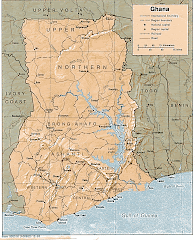
As of 5pm local time (11AM CST) I am sitting in a guest house in Accra (Ach-RAA) waiting for dinner. I leave at 6:30 for the airport. The plane leaves for Amsterdam at 10PM. I get there at about 7AM and get to sit and stew until about 4 PM when I get the flight to ATL and on to MGM, arriving there about 10 PM on Tuesday 5 January.
I have several posts in the works that I haven't beaten into shape, as yet. These will surface when I can, so please check back. In the meantime, I spent most of today writing the next book and walking a mile in one direction for lunch and two miles in the other direction for a cup of coffee and some banana bread. Breakfast is served only if you sign up in time (I didn't know this). Lunch is not served.
I arrived yesterday via a flight from Tamale (TAM-a-lay). The hamarttan has relented for the time being and planes are flying again.
Monday, January 4, 2016

Friday, December 25, 2015
T'was the Night in Nalerigu
T’was the night before Christmas, I was beginning to crash,
When two boys from the village got into a stash,
Of their grandmother’s cassava. She was saving it special,
And had it back of the house, there, under a kettle.
But, it, they had found, slicing it up for a snack,
(The stuff kills if not washed up and cooked right)
And they gave that a try, by the time that I saw them,
Retching and puking themselves on beds in Men’s Ward. Then,
Under the lights that are kept on all night,
To make the rats bashful or put up much fight,
Over food that is lying about in the ward,
Or get over-bold and gnaw charts, I wrote orders.
The boys got their IVs and charcoal, as well.
And, this time it worked. God has mercy for fools.
So I walked back to Six, through the silvered moonlight,
That you get when the hamarttan’s blowing just right,
In time to change, get some tea and a biscuit,
And go off to rounds on the fevers, and boils,
Malaria, the typhoid, the burns, the kwashiokor,
TB and ulcers of skin, gut and soul,
Which characterize, in part, the Fall of us all.
The kid in bed two is a pitiful sight, skin taut over bone,
Sighing gasps show his gauntness.
We have tried all we have. All to do we have done.
Yet, every few days, he’s a fever, despite us.
Then there is the girl with the compounded fracture,
Which the local healers set, two weeks ago Tuesday,
Her arm, she can’t feel, not a finger she moves,
It looks like raw meat; it stinks and it oozes.

By five PM, all we doctors are gathered,
In the front of the clinic, with bushels, we’ve come,
With oranges and good will, we go to the bedsides,
We’ve left just before, with frowns and concerns.
We’ve come back, now, with spouses and children,
And in one case a puppy, ‘though he stayed outside,
To sing to our patients, of Jesus first Coming,
To sing alleluia, to staff nurses and aides,
To sing of a Virgin, alone in a stable,
To sing of a Miracle, expected by none,
To sing to the people in pain and in danger
To sing of saving from care and from sin.
T’was the night before Christmas, I’m too tired to eat.
But among Jesus’ people I sing and I greet,
Such a great Christmas, the best I remember.
Merry Christmas to all, this dry warm December.(NB: It has been a practice since the early days of the Baptist Medical Centre, for the doctors and their families to carol through the wards.on Christmas eve and present small gifts, usually oranges, to each of the patients, their people, and the staff.)
Sunday, December 20, 2015
Night Noises

I arrived this time about six weeks earlier in the season and
Nalerigu is a far different place than what I experienced before. The night is
full of sounds. It has become difficult to sleep. Not that it is ever easy.
Thursday was a big night for funerals. I could locate two,
one with major detonations of some explosive. I could hear a shaman/land
priest/local healer/witch doctor screaming imprecations for about a half-hour
before the drums started up again. It was a school night and the whole thing
was over by nine.
I start going to bed about
9:30. It takes some time and it starts getting light at 5:30, so that is when I
get up anyway. Besides the usual stateside ablutions, brushing up and in and
over, I have to make my bed. This is complicated. One has to be sure the
mosquito netting, a cone suspended from the ceiling, does not interfere with
the ceiling fan, to dire consequences. The netting must be tucked in all around
so that it won’t drape over exposed skin, defeating its protective purpose. The
aforementioned ceiling fan must be ginned up so that a little breeze gets
through the netting and it is not so claustrophobic. Too much, of course, and
if I can get to sleep with the noise, I have dreams of being a slice of papaya
on a dehydrator sheet. Truth.
Finally, I to bed, comfy
enough if under-generous and limited by the enclosing net. I read until I can
doze off using a headlamp I bought for an Alaska trip. Practically like new.
Summer trip. I never used it.
It is then that the night
noises intrude: wolf-whistles, frog creakings, laughter that I swear comes from
a Three Stooges schtick of the forties. Just when I think I have gotten all the
acoustic signatures lined up, a battle breaks out in the “screaming bloody
murder” genre, setting my teeth on edge. The combatants gradually subside with
snarky comments back and forth before settling in. There is the slight shift of
the wind, and an owl outside my window asks unanswerable questions. In short,
it sounds like a Foley table from a cartoon with unlikely “whoops,” braying
calls (some from the musical donkeys about), yakking laughs, clanks, knocks,
dribbles, and the creak of a nightjar when all seems to have quieted.
I was called out on Thursday, my first full day back at work
after a run in with a gastrointestinal grippe of no small proportion but no
lasting significance. The man was lying unconscious in bed, covered in dried
blood from tip to foot, with a swathe of gauze wrapped around his head, stiff
and dark with more of the same. His buddies gave me the story: while riding on
his motorbike he hit another motorbike. The other fellow was not so badly hurt
and he went away, but their friend was knocked unconscious for the two hours it
took them to get him to a district center and then on to the “big hospital” a
Nalerigu. My patient was in his early twenties and a well-built worker-type,
his hands telling me what he could not. During my exam he woke up and was
cooperative. He was oriented and had no localizing signs. His retinas showed no
hemorrhages. There was a certain ethanolic scent about him. Examining the wound
was a process: soak the stiff bandages with saline, peel away a few square
inches of gauze, repeat. When we finally got down to cases, my young friend’s
wound was singular: a deep curvilinear gash on the top of his head, deeper in back and shallowing in front, about six
inches long and down to the bone. I asked, “What happened?” He said “They
attacked me.” “And you were running away.” He nodded.
By the next morning when we got down to putting it back
together, the assailants had miraculously become a bridge abutment. When we
asked how it came to be on the top of his head, it became a bridge girder. It
closed with 3-0 nylon. He should have a nice scar.
During the dry season, the local constabulary close some of
the roads east of here toward Nakpanduri because of tribal tensions. At the
end, a few bodies might be discovered. Think Hatfield-McCoy, if you want to go
that route.
As I walked back from seeing
my head wound patient about 2 AM, through the shadows now thick with dried
leaves, rustling in the wind, I looked up at Orion, too big by half than what
we see at home and lying on his back, as he does this far south, I pause. It is all there, just like my father pointed out to me
as a child. The three stars of the belt, the red shoulder star, the sword with
its fuzzy central gem, the lion skin skein of stars facing off against the
Bull, his one eye, red with anger. The night hides and reveals. It is a
privilege to be here.
Monday, December 14, 2015
The Hamarttan
Hamarttan
The Hamarttan started blowing a week ago. It starts subtly,
barely noticeable in the rattle of falling leaves. The ridges in the distance
are just a bit imprecise, an impressionist painting rather than a photograph.
During the day, it is no cooler, the mid-nineties, but at night the temperature
falls after midnight to a bone-chilling 64⁰F. I am not kidding. The Ghanaians
are chilled to the bone. Living in concrete or rammed-earth constructions, heat
insulation is a foreign concept. Fires are for cooking and not heating. No
other fabric is available other than the gaudy, imaginatively printed batik-decorated
cotton.
The hamarttan is a wind that blows from the Sahara to the
Gulf of Guinea during the dry season. The Sahara, super-heats during the day,
creating a fixed high pressure zone, while the Gulf of Guinea, off the coast of
Ghana has now cooled down. The wind picks up the finest particles. It is dry,
and reflects the sun back, cooling the night. I have never been to the desert
but I know its taste. Fine as talc, the dust gets into everything. Surfaces
whipped clean at noon have a fine coating by dinner. The air becomes hazed with
the dust, noticeable from ten feet off and enclosing us seemingly in a great globe
of dust a few hundred yards wide. This is just the beginning. Ghanaians say
that the wind, when it is bad, rattles windows and causes scorpion bites and
skin rashes. (More scorpion sightings this last week …remember to turn out
shoes left at the door overnight). It does give me a sore throat and a cough.
The leaves are dropping, leaving the branches bare except
for the ‘frangi-pangi” tree with each branch adorned with a single place yellow
blossom at the very tip … and its lovely scent.
Received a 1.1kg (2# 6 oz.) baby last week. In the states,
at delivery, the infant would have been immediately placed under a warmer and,
except for a few rude intervals to get weighed, would never be far from a
carefully warmed and protected environment. This little girl delivered at a
health center. The mother was told to bring the infant to maternity at BMC,
just down the street. She walked. By that time (60 minutes) the infant no
longer had a measureable body temperature. The infant was transferred to
Paediatics because we have the functional incubator. At 90 minutes I became
aware of her and popped her into the incubator after only about 15 minutes of
filling out forms (I sometimes think all of British rule was a ploy to
infiltrate an entire continent with self-sustaining bureaucrats). Over the next
three hours, every time I went to find the baby, she had been removed from the
one effective treatment option I had: to place an IV, to feed, to be bathed
(bathed!). At 4 hours, after never having gained a measureable temperature she
became apneic and was again removed. When I found her she had the cold
grey-blue color, the clammy cool skin and the absence of a heart rate of the
newly dead. I spent some time showing people how to effectively use a bag-mask
to breathe for small infants. The death forms are very bureaucratic … and
familiar.
Cause of death: respiratory failure due or in consequence to hypothermia due or in consequence to prematurity.
Bureaucrats never give you enough space.
On a brighter note, malaria is on a bit of a holiday, we
only admitted about six overnight. No new cerebral malarias. Enteric fever
(probably Salmonellosis or Shigellosis if we could get the labs) is in a
resurgence. We several docs watch the fever curves assiduously, looking at each
peak and its aftermath, rather like overanxious grandmothers.
My burn patient is doing well so far. He suffered blisters
to most of his back after “pulling the soup off the fire.”
“How is it that the burn is on his back and not his front?”
“We do not know.”
The dry season is the season of burials. That is not as grim
as you might imagine. Generally, roads are better during the dry than the wet,
and easier for travel. The malaria season is just too busy for anyone. People
who die at other times of the year are buried rather rapidly. Then the family
prepares for the funeral, this might take two years more. Afternoons and
evenings are filled with the sounds of the big drums, beating an incessant
rhythm, well past midnight. The area has three main faiths: Animism (over 65%,
Islam 20% and Christian (Assembly of God, Baptist, Jehovah Witness and
Catholic).
 Animism (here since the earliest records) is administered by
land priests, “shamans,” witch doctors, or however you wish to name them.
Children I see frequently have ritual scarification around their navels (to
reduce the almost universal umbilical hernias, and since they go away anyway,
appear to work). The scarification is quite skilled, slicing through thin
infant skin only partway, deep enough to scar but not deep enough to create a
gaping wound. Some people I see have hundreds of them, collected over years of
successfully treated (or non-fatal) illnesses. Many children wear medicine
bags, filled with Who Knows What, and carefully sewn into a tidy amulet.
Animism (here since the earliest records) is administered by
land priests, “shamans,” witch doctors, or however you wish to name them.
Children I see frequently have ritual scarification around their navels (to
reduce the almost universal umbilical hernias, and since they go away anyway,
appear to work). The scarification is quite skilled, slicing through thin
infant skin only partway, deep enough to scar but not deep enough to create a
gaping wound. Some people I see have hundreds of them, collected over years of
successfully treated (or non-fatal) illnesses. Many children wear medicine
bags, filled with Who Knows What, and carefully sewn into a tidy amulet.
Islam came in with the Mamprugu Empire in the 13th
century and its attendant Saharan slave trade. Slaves for Gold (Ghana was the
Gold Coast). Many tribes, including the Malaprusi and the Dagomba, have origin
stories of escape from the Nile Valley to escape Muslim slaving operations.
Nevertheless, the Malaprusi have a veneer of Islam being for the court of the
Niyiri (paramount chief), if not a state religion, at least an ornament. A Muslim
must hold the throne for the Niyiri on his assent. Muslims are viewed as
wealthier and they allow a good deal of syncretism with Animism. To become a
Christian means a concrete break with the past. Old relationships end. Killings
for converting from Islam, fortunately, have never been a large part in this
country. To become a Christian is to put off the old things of a person’s life
and to accept a new one, one with no reassuring icons, totems or amulets. It is
tough. People’s joyful exuberance in the celebration of worship is
understandable.
It is the Christmas season … and one can barely tell. If it
were not for the (artificial) Christmas trees (a pagan holdover from Yule, the
holiday at the winter solstice) I would not know it was. Nine more shopping
days to Christmas.
Thursday, December 3, 2015
The Hunt
This would not end well for one of us. She had already
tasted my blood, and I was now out for
hers. I should have been warned. All
evening, that busy, crowded evening, I had caught just the suggestion of her
high pitched cry. I had stopped each time, trying to localize it, track it, in
the world of noise: native drums, cries, a ceiling fan, clunking and slashing
its way to its inevitable destruction, and the myriad of night birds’ calls, I had lost her cry each time.
I had known, of course, her power to wound and kill. The
long, warm wards lined with pale, fevered
faces, the fetid smells blowing in from
the choo, the empty beds that greeted me
each morning were proof enough of that. She is
capable of so much damage. I have seen her take even small children,
days from the womb, eyes staring in horror, or closed in resignation as they
die. She works with other beasts, of course, but you know she is there, out
there, all the time.
After a long day and a troubled evening, I retreated to the
safety of my protected haven, feeling my anxiety melt from the taut attention I
had not known I had devoted to her. She would come closer in the night,
circling my place, but I was safe, within. Almost immediately my eyes were
closed. Perhaps I slept. The nights are so warm,
and the rushing air of the fans cools only by imagination. I wager she came
through the window, past the zamu, the
guard. She could have been there all the time, hiding in a corner, waiting for
me to come and lock us in together, so she could feed.
I was awake enough to rouse as she started. She was wise enough
to leave her meal as I roused.
Now, despite my internal armor, I am at her mercy. She
always leaves a little of herself behind. Even so, I will find her, and we will do battle.
I turn on the small light and look inside the cone of my mosquito netting that covers my bed. She is there somewhere, waiting for me to fall
asleep again, so she can feed again. I see her in a faint crease and launch an
attack. She flies off. I bring out the big guns and the next time she lands, my
pillow comes away with a large smear of blood, my blood. I have been avenged. I sleep.
At BMC Nalerigu, Malaprusi
District, everyone is presumed to have malaria, to have just been over it, or to be just about to
get it. Safe money. The female Ades egypti
mosquito is the final vector. Malaria complicates all disease, weakening the patient and opening the door to other diseases in those she does not kill outright. I should have looked for her before I turned out
the light.

Monday, November 30, 2015
Trip to the Wall
Having a half-day free on Saturday, I decided to walk to the
Nalerigu Wall, about two miles distant. The wall is old and its history is
complicated. People do not frequently slow down enough in their rush to the
future to post a sign about what they are doing, Facebook notwithstanding.
However, in this case, the Nalerigu
Wall is well documented to be from the 17th century, built by order
of a Na Atabia (1688-1742), the king of the Mamprugu Empire (begun about 1350
by the “the red hunter,” whose army took most of NE Ghana, southern Burkina
Faso, and northern Toga) from the indigenous farmers who had been there already
for centuries. The grandson, Na Gbewa, held the empire together but his sons
would not. They split it (amicably) into four kingdoms, each with its paramount
chief. The Malaprusi chief is the Niyiri and is much honored and venerated by
Malaprusis as well as the three other “gates” of the former empire. In turn,
Malapruli princes have spawned other kingdoms further west. The Nyiri’s real
powers, however, have been limited to judicial decisions since the coming of
the republic in 1957. It is not really an inherited post, yet there has been no
sanguinary conflicts to gain the paramount chiefdomship. Candidates must have a
paramount chief as a father (not a unique distinction, he has 12 wives) but
then must have gone through a rigorous tutelage of being a sub-chief of one
flavor or another inside the larger kingdom, before he might claim the “lion
skin” upon which rests his throne in his palace in Nalerigu. One requirement is
that the candidate must be able to recite his lineage back seventeen
generations to Na Atabia and the “red hunter.”
At any rate, Na Atabia was anxious to encourage trade (Slaves
mostly sold for gold by Muslim traders) from Toga to Gambaga (just down the
road a bit). Predation upon caravans was getting irksome and the fortification
was erected to house warriors and, not surprisingly, tax collectors. The ruins
remain.
I start at 2:30, when the town is beginning to stir after
avoiding the hottest time of the day from 11AM on (98 degrees by 10 AM, actual
measurement). The sounds heard while walking through town are an experience: a
cover of Bob Marley’s “Buffalo Soldiers” sung in Arabic, harpsicord music,
Ghanaian patriotic songs, family arguments and “Frosty the Snowman.” Children
and younger men and women try out their limited English (the official language,
Ghana has a couple dozen languages but no one understands them all) on the
funny white man.
If anyone passes close it is important to acknowledge them
with a greeting. The response to any greeting is “N-aaah” which mostly means “I
acknowledge your greeting.” Dodging leaky and, at times, truculent goats, the
odd pig, chickens, motorcycles and motorcycle-energized two-wheel carts takes a
certain dedication of purpose. I pass three mosques and three churches. The
smells of the town waft back and forth: grilling meat, wood smoke, fetid
aromas, dust, humanity, and gasoline. Most of the commerce is motorcycle carts
selling 50 gallon drums of water as well as the ubiquitous plastic water
packets containing about 8 oz. of filtered water. The discarded packets for
Bisvel Water are everywhere. I am able to get up to the Via Gambaga within 25
minutes and know to turn west on the road to get to the reservoir. This affair
is probably 20 acres and about 6-10 feet deep. You do not drink from it.
Potable water is Bisvel Water or wells, some dug by my friend Tommy (see a Day
with Tommy in this blog).
Once I get within range of the reservoir, I find a way to
cross the small outflow downstream from the earthen dam without confronting
some pigs, hock deep in the mud and looking proprietary about it. I have no
idea where “The Wall” it is except “near the reservoir.” I start to circle the
lake, about a three mile circuit. Luckily within about a half mile I find the
best preserved specimen (pictured). The highest segments are only about 7 feet
high but the plan is massive.
 The wall is made of an odd concrete-like adobe
made in a huge circle. It was constructed using slave labor to safeguard the
slave trade. At the time of its construction, Queen Ann was ruler of America.
America was three generations from its conception. Ghana was old even then, old
and civilized and it had been for a millennium.
The wall is made of an odd concrete-like adobe
made in a huge circle. It was constructed using slave labor to safeguard the
slave trade. At the time of its construction, Queen Ann was ruler of America.
America was three generations from its conception. Ghana was old even then, old
and civilized and it had been for a millennium.

I came back through town on a parallel road, passed the
Niyiri’s digs, very impressive in a concrete and steel sort of way and stopped
near the (Bus) Station because my purpose-bought phone would not recognize the
sim card I bought for it just last week. The Vodaphone shop was nearly empty
this late in the day (5:30 PM) and the young proprietor motioned me forward
almost immediately. I showed him the “no SIM card” warning and he opened up the
back, turned the card over and gave me a long hard look before he closed things
up again. All fixed. He refused to take any money. I wish he had not.
Wednesday, November 25, 2015
Happy Thanksgiving from Nalerigu
Wishing all of you a very warm and happy Thanksgiving. Guys! Volunteer to clean up! The look of astonishment and disbelief, by itself, is worth the price of admission.
In Ghana, this is the fat of the year. The maize harvest is in, of course, and the rice is coming in now. I can see men on bicycles with huge sheaves binging it in to be threashed. The trees are just beginning to lose their leaves. By the end of the dry season, all the green will have become gold. The trees will be barren and the nice patches of shade as I walk to and fro will be but a lacework of shadows. Then things will get tough.
 Still, the malaria season, falling as it does immediately after the Wet, is trying for all, children
most especially. Their nutrition, never the best, is knocked off the fence by each bout of malaria and then comes the lean times of the dry season.
About half of my patients in the ward (some fifty or so) are here for malnutrition. I am measuring swollen bellies all day, for reference sake. While I was rounding this morning a child was brought in from Emergency in the last stages of starvation. It was the first time he had been seen by a doctor. It was the last as well.
Happy Thanksgiving. Please give thanks to the Maker and Sustainer of this world for the bounty we Americans enjoy, the health that lifts us all up and peace.
Dr. W
In Ghana, this is the fat of the year. The maize harvest is in, of course, and the rice is coming in now. I can see men on bicycles with huge sheaves binging it in to be threashed. The trees are just beginning to lose their leaves. By the end of the dry season, all the green will have become gold. The trees will be barren and the nice patches of shade as I walk to and fro will be but a lacework of shadows. Then things will get tough.

most especially. Their nutrition, never the best, is knocked off the fence by each bout of malaria and then comes the lean times of the dry season.
About half of my patients in the ward (some fifty or so) are here for malnutrition. I am measuring swollen bellies all day, for reference sake. While I was rounding this morning a child was brought in from Emergency in the last stages of starvation. It was the first time he had been seen by a doctor. It was the last as well.
Happy Thanksgiving. Please give thanks to the Maker and Sustainer of this world for the bounty we Americans enjoy, the health that lifts us all up and peace.
Dr. W
Monday, November 23, 2015
Back at Nalerigu
I spent the night at the Accra Baptist Guest House on the 20th Nov, had an interesting conversation with a couple from Oklahoma going home from a teaching mission in Kumasi. Dinner was hamburgers which were good. Any American travelling abroad knows how remarkable that statement actually is.
I got my American cash exchanged in Ceti. Surprisingly, this term is a hold over from the origins of trade along the Gold Coast, what Ghana went by in my youth. A ceti originally meant a "stick" of two hundred cowrie shells, presumably after the snails who inhabited them had been asked to leave. The New Ceti was worth fifty old ceti or 10000 cowrie shells. It is now worth about $0.26 and is one of the stabler West African currencies. It is divided into 100 peshewari which is a name derived from the colonial days, meaning the smallest coin available and made of gold.
I had to get up at 4:15 to make the plane to Tamale after a night disturbed by the cries of black kites, guinea fowl and extremely low flying jets. The Cantonments are just south of the airport.
The three hour trip from Tamale to Nalerigu was an experience. The rains had rutted the roads into a maze best navigated free-style. It has been three weeks since the last rain, which is the last rain for about four months. The dust right now is minimal, nothing like the several feet of flour-fine redness that will cover the roads in drifts by season's end. The short paved bits were taken at 70 mph, goats included.
Baptist Medical Center is very much as I remembered it. There are new buildings, partially finished and vacant, still crowded wards and solemn zamu guards that open the screen doors for you before you know they are there. I am staying at the same guesthouse as before, although the only resident at the moment. My room is has a single bed, a ceiling fan and a naked light bulb. Bowa, the house cook, my cook, has a two-week menu posted for the residents but not for reference, it appears. “TIA- eat what you get.”
I got my American cash exchanged in Ceti. Surprisingly, this term is a hold over from the origins of trade along the Gold Coast, what Ghana went by in my youth. A ceti originally meant a "stick" of two hundred cowrie shells, presumably after the snails who inhabited them had been asked to leave. The New Ceti was worth fifty old ceti or 10000 cowrie shells. It is now worth about $0.26 and is one of the stabler West African currencies. It is divided into 100 peshewari which is a name derived from the colonial days, meaning the smallest coin available and made of gold.
I had to get up at 4:15 to make the plane to Tamale after a night disturbed by the cries of black kites, guinea fowl and extremely low flying jets. The Cantonments are just south of the airport.
The three hour trip from Tamale to Nalerigu was an experience. The rains had rutted the roads into a maze best navigated free-style. It has been three weeks since the last rain, which is the last rain for about four months. The dust right now is minimal, nothing like the several feet of flour-fine redness that will cover the roads in drifts by season's end. The short paved bits were taken at 70 mph, goats included.
Baptist Medical Center is very much as I remembered it. There are new buildings, partially finished and vacant, still crowded wards and solemn zamu guards that open the screen doors for you before you know they are there. I am staying at the same guesthouse as before, although the only resident at the moment. My room is has a single bed, a ceiling fan and a naked light bulb. Bowa, the house cook, my cook, has a two-week menu posted for the residents but not for reference, it appears. “TIA- eat what you get.”
I worshiped this morning, and early afternoon, at First Baptist
Church of Nalerigu. It is much as I remembered it: noisy, hard benches, nursing
mothers, passing babies from mother to auntie to auntie as needed, the long
prayers and the longer bi-lingual sermons. By far the most animated and joyful
part was the “parade” (my word) offering. Each row files up to the offering box
amid glad cries, singing, out-stretched arms and small offerings.
I am always uplifted by worship when I am abroad. The small golden
things of the spirit can be found more easily, perhaps, when one compares it to
the mounds of discarded shells which the world values more highly.
Friday, November 20, 2015
Making Sausage

Accra
Baptist Guesthouse
The
Cantonments, Accra, Ghana
Johnny Osusuwi was there waiting for me as I came out of the
terminal building. Reporters lifted their hairy microphones, signs expressing
welcome, affection and loyalty were raised from an adoring crowd … and then
lowered in that embarrassed fashion that one uses when discovering that it was
just some old guy and not “the band!”
Moments later the real band members (for a group I don’t know) emerged
and were engulfed by their adoring fans. Traffic was worse than usual.
The trip was “nominal,” I presume because someone named it “long
and boring” and it lived up to the advertising. I have observed before that air
travel is like sausage-making. One starts at one end and moves through metal
tubes of various sizes to be deposited at the other end, transformed and most
likely unrecognizable. Some of the tubes jiggle and in those attendants bring
you food and drink at intervals. Other tubes do not vibrate but you have to
fetch your food yourself. Like sausage and lawmaking, the actual process
should, perhaps, not be described in polite society.
The longest leg of the trip, of course, was from New York’s
JFK to Accra, the capital of Ghana and its largest city. My time on board was
shared with a young lady who eventually slept with her feet in my lap, ate my
lemon drops and tried, unsuccessfully, to steal my cookies. Avery is eighteen
months old and travelling with her mother back to Ghana to see her family for
the first time.
Stepping down from the plane mid-morning, I encountered the
smell of Accra: distant wood smoke, humidity like a warm comforter on a warmer
evening and the faint fetid smell of the Gulf of Guinea. The night before I
managed to get about three hours’ sleep, packing an entire bag filled with mardi
gras beads, kool-ade, stuffed toys, soccer balls, EKG machine, transcutaneous oximeters,
various books and a single can of strawberries. Anyone going up country becomes
the default omnibus carrier for all the missionaries there. I am extremely
lucky to have a friend in Linnie Dickson who helped me wrestle this beast into
his car and dropped me off at 5AM on Thursday morning the 19th in
order to start the sausage-making.
All that said, I had over a hundredweight of impedimenta for Johnny Osusuwi to
wrestle into the elderly Datsun before we braved traffic on the two lane
highway that ground away from the airport. Sometimes, if a stretch of road is
not being used convincingly by the oncoming traffic, entire lines of
automobiles, trucks, matatus (not a really correct name as it is Swahili and I
am in west Africa), motorcycles and bikes postulate one or two additional lanes
of travel, double yellow line notwithstanding. Auto accidents are frequent and
mortal.
After changing my money into Ceti and getting a local sim
card for my phone, I was deposited at the Accra Baptist guest house by 1030. My
room was ready: small, walls entirely of window, ceiling fan set to “sweat
copiously despite use” and a large hard bed. I perspire and doze until
mid-afternoon, repack my bag for tomorrow and go to dinner. I leave at 4 AM to
get a flight for Tamale (TAM eh lay). The real trip begins.
On the road. Thank you for your prayers.
Dr. Walt
Friday, November 13, 2015
Getting Ready to do it Again
After so long, it seems odd to re-activate this blog. Since leaving Ghana I have been on a number of mission trips. Much has happened at Baptist Medical Center in Nalerigu, as well. Dr Faile, of course, has retired and my good friends Cindy and Paul Shumpert, have been working tirelessly (well, continuously) to find materiel and personnel to continue BMC's mission. Most of you may be aware that the original sponsor for BMC, the Southern Baptist Convention, has been withdrawing support for medical programs for decades. BMC is on its own.
I accepted an assignment here over the holidays to help in a usually thin part of the schedule. As a physician, all holidays are "moveable," of course, none being guaranteed to occur on time or in that idyllic non-time of celebration when the larger world agrees to be held at bay.
This time, however, I will at least be leaving healthy. I hope to stay that way and not become a burden on the resources like I managed to do last time.
The weather I expect will be very similar to what I experienced last time, the dry season. It will be earlier in the season, so I hope that the malnutrition, malaria, and fevers will be less mortal to my marginalized population. Last time, malnutrition clinic, an outdoor affair among the mothers and babies who collect around a government feeding station, was a three times a week intervention of mine to find the kids who were sick enough to be admitted.
I am collecting stuff. Once people know you are going out, you get the emails to take along "a few things" for someone already in the field. My porch has been committed to the collection of piles of books, medical equipment and "stuff." I will need a second bag.
I just published my first novel the end of October, Outland Exile (some of you will get it). You can actually go buy the thing now! If you want a signed copy at substantial discount ($12.95 +S&H) you will need to wait until I return in January, however. http://oldmenandinfidels.com is another blog on writing and the books that I will keep up in the usual dulsatory fashion. I hope to finish book two while I am gone.
Lastly, I covet your prayers for guidance, strength and health. My next entry should be from Ghana.
I accepted an assignment here over the holidays to help in a usually thin part of the schedule. As a physician, all holidays are "moveable," of course, none being guaranteed to occur on time or in that idyllic non-time of celebration when the larger world agrees to be held at bay.
This time, however, I will at least be leaving healthy. I hope to stay that way and not become a burden on the resources like I managed to do last time.
The weather I expect will be very similar to what I experienced last time, the dry season. It will be earlier in the season, so I hope that the malnutrition, malaria, and fevers will be less mortal to my marginalized population. Last time, malnutrition clinic, an outdoor affair among the mothers and babies who collect around a government feeding station, was a three times a week intervention of mine to find the kids who were sick enough to be admitted.
I am collecting stuff. Once people know you are going out, you get the emails to take along "a few things" for someone already in the field. My porch has been committed to the collection of piles of books, medical equipment and "stuff." I will need a second bag.
I just published my first novel the end of October, Outland Exile (some of you will get it). You can actually go buy the thing now! If you want a signed copy at substantial discount ($12.95 +S&H) you will need to wait until I return in January, however. http://oldmenandinfidels.com is another blog on writing and the books that I will keep up in the usual dulsatory fashion. I hope to finish book two while I am gone.
Lastly, I covet your prayers for guidance, strength and health. My next entry should be from Ghana.
Sunday, February 17, 2008
Home Again Home Again Jiggity Jig
We (Paul Shumpert and Doug Johnson and I) left Nalerigu at 5:30 AM on Tuesday the 12th last. We drove thru the night to Tamale (TAM-a-lee), dodging donkeys, chickens, goats and cattle who had taken over the road and its residual warmth at night. We arrived at the newly refurbished airport and got through security with little problem. I have failed to mention in these proceedings that the entire backdrop for this mission trip has been the African National Cup games which started a few days after I arrived and continued until the Sunday before I left. Ghana Ghana was in contention for the entire time until a loss to the Cameroons on the 7th February. There was no joy in Mudville, on that occasion. However by now the solace of a 3rd place, consolation victory had turned people’s spirits around from mayhem to “wait 'til next time.” The upside was a number of public work projects, including the Tamale airport.
Our flight to Accra Accra
We are staying n the “Cantonments” section of Accra
We spent exorbitantly to about 35USD for the 3 of us. We then walked from there to the “African Market,” just a couple of blocks from the Gulf of Guinea
Rules for the “Cultural Centre” 1) Don’t stop if someone calls you “Papa,” 2) Don’t stop if someone says “Just look for a second” 3) Never tell anyone what you have to spend. 4) Wear dark-glasses 5) Always hear the sellers price first 6) Act dismayed at the avariousness of mankind and this particular example thereof 7) Quote a price one fourth to a third what was quoted and no more than half what you are willing to spend. 8) Always be willing to walk away unless the price quotes move down in proportion to your moving up 9) the negotiations belong to the guy who cares the least.
I made a few small purchases (an enameled pin and a koooshwa, a rattle) for a few cedi apiece and Paul and Doug made similar small purchases. The cultural center must be taken in small amounts. If you are once identified as a “buyer” people materialize from everywhere to have you see their wares (many of which are quite fine and a goodly number are dreck). We westerners are probably too polite by half and it takes a good deal of time to extricate ourselves.
The rest of the afternoon is spent trying to stay cool and checking our mail. Dinner at the Baptist Guest house is chicken parmesan, the same as I had going out as it happens, the menu is not extensive and it is Tuesday again. I meet and start talking to Andrew who sports the lilting tongue of an Ulsterman from Belfast Ghana Ghana
We sleep like the dead and awake at 5AM to be sure to get to the airport to check in. What we learn today is not good, however. The Monday flight had been cancelled due to a bird strike hitting a jet engine (seagull flambé?) and all those passengers have been carried over into today’s flight. Delta has booked another flight to Atlanta Atlanta
The Atlanta
We finally get on and situated. The flight is about 12 hours long during which I saw some little bit of West Africa, several movies of dubious significance, several meals of indifferent flavor and a good deal of the inside of my eyelids. Our connecting flight is scheduled for 8:30 PM. We do not arrive until about then and still have to go through customs and immigration. We have no hope of making our connecting flight, the last of the night. We go to get our bags only to discover that a large number of bags are waiting to be claimed and a large number of passengers are also waiting for their bags. It appears that most of the JFK bags got on the ATL flight and vice-versa. After a long tine to get our new flight, hotel vouchers and directions. We dash between buildings in short-sleeves (what jacket I did have was in my suitcase) until we can get a shuttle to a local hotel. I spend until 1 AM trying to find a limo home as all previous plans have been scotched by the delays.
I meet Paul for the shuttle the next morning and we check-in with little trouble. Not surprisingly, the flight leaves an hour late, but we are assigned to first class in a Boeing 777. I notice on sitting down that the man next to me has a New Testament and I strike up a conversation with Pastor Rucker of Pickens County Georgia Accra
On arrival we find our bags and Paul sprints off to get his shuttle, Doug has a plane to catch and I still have no way home. After about an hour, I get a one-way rental to Montgomery
I thank all of you for your prayers and concern.
Sunday, February 10, 2008
A Day with Tommy
The hamartan has been over for a week and each day brings a hotter temperature and a more restless night. At 530AM, making virtue of necessity, I get up. Breakfast is black coffee, small local bananas and toast.
I head to the hospital early as I will be spending the day with Tommy. (He will not let me use his full name.) However, I can think there is no one who has come through Nalerigu who does not already know Tommy. He is greeted by shouts of “Tommy!” from passing tractors and by solemn handshakes from village chiefs. Tommy has been in and out of Mamprusi districts for almost 25 years. He “works in the villages” among the 
Compared to other missionaries of my acquaintance, Tommy lives an austere life. He lives in Nalerigu proper (rather than the hospital compound) in a house with a single common room/kitchen, and a small bedroom. He has a Ghanaian cook and a small watchdog, named “dog.” Tommy lives entirely as a Ghanaian. He is bald, tanned to a crisp and well into his 70’s. His speech betrays his small town South origins and he would be at home behind (or underneath) any John Deere known to the hand of
Tommy started coming to
We follow the ridge south through Nagbo where we pick up Rachel, “a faithful.” She has consented to help today. Wednesday, Thursday and Sunday (weather permitting) Tommy sees his small congregations among the villages. Rachel is in her mid-thirties and races over the forecourt of her home in Nagbo, remarkable because she has lost her right leg and is on crutches. We exchange greetings all around (“Dasubah… naaah… naaah”)
“Naah” by the way is one of those essential words one discovers in a language which makes one wonder how other languages get along without it. It has no precise meaning. It is a universal answer to all greetings and most social settings. It is said with affection and gusto and drawn out to a wonderful extent. When I asked one of the boys what it meant as an answer to a greeting he said immediately “It means you have been greeted.” The morning was filled with these brief greetings, as the truck stopped, people piled in or out; “Dasubah (“I greet you in the morning”)…naaah, naaah, naaah.”
We continue down the increasingly dubious road, the ridge becoming lower and less distinct as we travel south, past Tianoba, over the bridge and up to Joanni, and take the right turning to Tunni. Here we are to pick up a preacher for one of the other villages we will go through. However when we arrive we discover that the man’s mother has died that very morning. She will be buried before nightfall and already mourners are walking and pedaling from the countryside to attend. Burial is prompt in this warm country but funerals are usually all held in the dry season when farms are at their slowest, perhaps as much as 6 months after the event. The dry season is also when many of the older members are carried off by chronic disease or malaria.
We greet all the mourners on the road and continue on to Kaliba, a Kokoma village. Like Mamprusi villages, the houses are made of sun-dried brick with conical thatched roofs. Each house is a compound with round rooms for each woman and her young children, a square room for each man and a windowless low room for older children. The entire house is then connected by a smoothly plastered mud-wall giving it a pleasing substantialness. In
We stop in Nakpuliga, at the top of a rise since we see a school in progress. A typically African affair, it consists of a crooked wooden sun-screen and a tired blackboard. Tommy invites me to make the acquaintance of the school teacher. She is a young Ghanaian who seems quite in charge of her three dozen children ranging from 4 or 5 to early teens. All are solemn quiet and well-behaved. “Good Morning, Sir” is said with a deferential bow. All is of the highest decorum until I ask to take a picture. Discipline wilts against the opportunity to see oneself. Giggles, smiles and jostling erupt. A small bag of balloons has found its way to the teacher and discipline is re-established on the simple basis of bribery. The teacher, as I go is anxious to tell me her plans to use the school as the site of a church meeting.
We stop at the next village, Ba’ali, to drop off Rachel. We are greeted with enthusiastic drumming singing and step-dancing to a
Church planting is an irregular affair. Tommy notes that his ground work sometimes takes a decade of well-digging, friend-making, funeral–attendance and showing respect to the chiefs before “overnight” a group of believers is found and regular meetings are held. A major failure has been Nagbo, only a short distance from the hospital. This is primarily because of the attitude of the Muslim families whose children convert; they are locked up, without food or water until they recant. Many are then abandoned if they still refuse, giving up all for their faith. Even so this is preferable to the “honor” killings seen elsewhere under similar situations.
Tommy is extremely short-handed today and what might have been regular services are reduced to greetings and sharing the news of the death. Ba’ali is the destination for Rachel and we arrive to drums and singing under a shade tree. Rachel is introduced and we are off to Bakuli, a
We are off again and reach a large flat area, the floodplain. Near the river we see a large herd of very fine cattle. They are from
Once past the river we stop briefly at Sou, a Gombu village, to greet, share news and pick up a translator. Our final stop is at Tiini, literally “one tree.” That one tree is an impressive baobab, one of the largest species in the world. In the dry season, one can see why it has been described as an “upside-down tree. “ Its thick trunk supports short root-like branches and tiny leaves. We arrive as the celebration is in full swing. The service is held in a shade of the other trees. The congregation of about thirty, dance in a circle and sing the line-response songs so familiar in much of 
We greet the village chief and Tommy heads into the dancing, his translator having had the privilege of carrying Tommy’s Mampruli Bible in the dancing, Tommy has hand free to keep time with his hands. I make a round of picture taking, doing close-ups of the usually somber faced Gombu and then showing them the results on my camera. This immediately gives me huge smiles for the taking (which was my original intent). After several choruses, the dancers sit on wooden benches under the trees and Tommy begins. These are usually practical messages on Christian living. Today’s is on being known “by your fruit.” Tommy is an animated speaker even in translation and he gestures and points at the trees around us in explanation. He asks questions of the audience who respond in severalty and volume. The points are simple and to the point. Afterward I see a few children and we take the road back…rewinding the road as we had unwound it during the morning. The road seemed longer and certainly hotter on the return, probably about 100F but dusty and dry.
The road back was filled with talk of missions and methods. Tommy is very adamant regarding the mode of successful missions; he thinks that a missionary needs to imitate the culture, to live as and with the population. Tommy lives his convictions. Nevertheless, he is very supportive of the role of hospitals for Christian evangelism; medical missions have suffered an eclipse for the last 30 years despite its seminal role in opening many mission fields from Africa to
Tommy’s success also comes with private support; he supports himself and is not affiliated with any mission board. Nevertheless, as we collect and drop off people and produce along the way back to town, I wonder what a 21st century apostle would look like and I keep coming up with an image of Tommy.
Saturday, February 2, 2008
Feeding Babies
Daily I do rounds in Paediatrics, see the small babies in Maternity and then do sick rounds in “Nutrition, a feeding station for outpatient malnutrition patients. Twice a week I see all 3 dozen patients or so for evaluation of their progress.
Feeding stations are a staple of mission hospitals, either free-standing or in cooperation with the government as this one is. Mothers are admitted with all their children for supplemental feedings, lessons on food production and general child health like immunizations, malaria prevention and safe water tasks. One may not notice this at first as these tasks take place under the filtered light of locust trees in an area around an open-air tin-roofed affair. The furnishings are low benches, tables and the concrete floor. Across one wall, hand-drawn pictures illustrate fruits, vegetables and cereals (red millet is the favorite, known locally as “guinea corn”). Murals on the half-walls illustrate a market scene. A fortified room with heavy padlocks houses the supplemental food, sporting “A gift from
The give-away to the feeding station are the mats stretched out among the trees and the scrupulously swept dirt each morning.
Much of this belies the sophistication of the work being done. The subsistence farmers will do well during the wet season but slip into starvation during the “dry.” The diet contracts to merely millet and taro root; both of which tend to make malnutrition worse as they prevent absorption of some nutrients. Children, particularly after they are weaned are at special risk. Children do well until they are introduced to solid foods at about 5-6 months. It is only then that a fat infant starts a cycle of a relatively minor infections, a period of weight loss, a small rise and then another failure. It is not uncommon to see a child lose weight from 5 to 14 months, weighing 12 lbs when identified.
Their diet is “koko” or “tizit,” essentially millet porridge or gruel respectively. Considering that a child then is a greater risk for contracting malaria, typhoid and parasites compared to an adult, it is not hard to imagine such a one “being knocked off the wall” and sliding in to marasmus or kwashiorkor.  The first is total nutritional deprivation with muscle wasting and the look of the aged in the eyes of a 9-month old. A stethoscope cannot find enough tissue between the ribs to make listening easy.
Kwashiorkor is a protein malnutrition with the pot-belly, swollen legs, red hair and pale skin of numerous “poster children” for famine of the last 50 years. These have to be treated with caution as rapid re-feeding is associated with sudden death as malnourished hearts try to accommodate the changes. These children in particular need a “complete” protein. No vegetarian protein source is “complete” for human infants. Each by itself would gradually produce protein deficiency.
The answer is remarkable. The Nutrition station makes its own variety of “koko” (porridge) from millet (very much tastier than maize) and soy beans. The right proportions are coarsely ground in a wooden mortar, retaining the husk of the millet, (which is usually removed my soaking otherwise). The coarse grounds are lightly roasted and and then finely ground to a flour. I exaggerate in no way by saying this stuff is good! It produces a porridge with complementary proteins from the two sources, very much closer to an “complete” protein.
I go over all the weight curves and treat all the acute malarias, pneumonias, typhoids and such of the “well” kids; admit the 4 or 5 who need to be hospitalized for the same problems and admit the 3 or 4 who have finally “failed” in a bid to gain weight. These may die in hospital from their malnutrition. They of course, die of some disease like malaria or meningitis but the bottom line is that they arrived at death’s door merely from starvation, the “intercurrent” disease merely ushers them through.
I frequently hear travelers who come home complaining that the unsophistocated natives of the “third” world imagine that all Americans are rich. Considering never fearing starvation as a measure of immense wealth, I wonder who the naïve one is.
Wednesday, January 30, 2008
Empty Spaces
I was called at 4:15 on Monday morning; the “well” preemie in maternity was having respiratory distress and the midwife had started oxygen. I pulled on same scrubs, strapped on my “fanny pack” filled with my medical tools, a couple of books, a hand-sanitizer, insect repellant and a small camera and walked up the hospital. The ‘hamartan” was blowing briskly, the moon was up and the road was easily visible until it got under the drought-stripped locusts. The drums which I had heard at sun-down continued now; a local chief had died and the “death house” was a scant couple of miles over the next ridge east of here. The creaky-gate call of a solitary fruit bat ticked off one per second. I didn’t bother with my “torch” for the quarter mile walk.
I met and passed a few Ghanaians’ with a polite “najanuri….naaah” formula (good evening…. *acknowledgement*) and crossed over into the maze of concrete steps and ramps which is the sign of a rural hospital in Africa . Electricity is never taken for granted and all areas can be reached by gurney and muscle- power. I turned down to maternity and into the nurses’ station to find my 5 day old patient. He was vigorous and feeding well by cup just this afternoon.
He really did look sick. He was breathing fast, pulling in between the ribs as he did so. His heart tripping along at almost 200 beats a minute. I washed my hands and started to examine him; involuntarily pulling my hand back as I started. He was HOT. The reason became apparent. The ancient incubator had two settings: “Off” and “On”. The nurses, taking counsel of their own discomfort at the cool weather had turned on the heat and left it on. The baby’s temp was 38.5C, about 102.7 or about 5 degrees Fahrenheit higher than it should ever have reached. I had the heat off and the incubator lid opened. Wrote some instructions about measuring the infant’s temperature to determine his care and went to see my other little patient who was on the ward. He looked no worse than he had that evening, warm but having some trouble breathing himself. I adjusted his position, replaced a water bottle and went back to the house.
At 5:15 I was called that my baby on the ward “had stopped breathing.” Something is usually lost in the translation of course, as the messengers are merely ward workers and not nursing staff. I asked if this meant he had died; a blank stare and a shrug was the answer as they turned back into the darkness. I followed them shortly, and arrived ahead of my own orders.
The reality was rather closer than I wanted. He was gasping again, heart rate (again) in the 60’s, pale cold blue and dead looking. I called for the breathing bag (the hospital has one for infants) and started to stimulate him to breathe (a maneuver which is not likely to work without the bag). He gasped and gave a squeaky breathe. Looking more carefully, with my “torch” I could see he was not breathing through his nostrils as they were completely obstructed with dried mucous. I cleared a bit away, got the bag and started to breathe for him. His heart rate once more responded. The next half hour was a modestly disgusting routine of suctioning his small nose of sticky secretions, adding saline drops, and suctioning again. Gradually, his breathing regularized with no squeaky sounds. I gave him some aminophylline to (hopefully) stimulate his respiratory center. By now however, he was again truly cold. The sun had still a half-hour before its debut and we were out of hot water.
Thinking things were at least stable, I went back to “house six” made up some breakfast and recharged the bottles with hot water from the geyser. Walking back, a box of bottles perched on a shoulder, with breakfast in hand, I considered that I had defeated the powers of disease and chaos rather handily. I swung into Paeds with my burden as rounds were starting. His bed was empty, the family gone and a few cold IV bottles surrounded the emptiness. An empty space.
I rechecked on my baby in the incubator. His temperature was normal, all signs of respiratory distress was gone, he was pink and well perfused but not feeding as well as previously. Considering he was most of the way to “well-done” a few hours previously, I was content.
In mid-afternoon a maternity worker brought me a chart. Scribbled at the bottom of the nurses’ notes: “baby stopped breathing. Chaplain called. 1403.” Another empty space. So far all small or sick babies who have been admitted have died.
Friday, January 25, 2008
Hot Water
[Update: UAB med student, Dough Johnson was hit rather heavily by the local gut bug (? Nalerigu Wringer?) and was out of work today. He is mending and may be able to return to work tomorrow. I am mostly over this pneumonia and thank everyone for the prayers, it has made all the difference]
Hot Water: a simple concept of course, you take cold water and apply heat.
The baby was premature at birth 2 weeks ago but had grown and the midwives discharged the infant last Sunday weighing about 5lbs 6 oz with instructions to come back to the hospital (a walking distance away) if anything should happen. By the time “something had happened” on the morning on Wednesday and the parents had worked their way through the long lines and had been seen by a medical assistant and had been identified, had worked through the lab and had gotten to the ward, it was 5PM and we were at the door to leave.
He was small frail, cold, blue and gasping. His heart rate was fast and thready. I examined him and as well as I could tell, he had no pneumonia, abdominal catastrophe, trauma or “localizing sign.” He was just dying. Back home we would probably talk roundly of “late neonatal bacterial sepsis” would get labs as appropriate, would start an aggressive course of fluids, pressors, mechanical ventilators, steroids and antibiotics. He would be tubed and “lined” monitored and measured.
What we had was IV fluids, low flow oxygen and precious little faith. A spinal tap was done quickly, once the IV was “set,” antibiotics were given and I set about to see if we could reverse the inevitable. We pushed in saline to open up his collapsing blood supply but within minutes his faint breathing stopped and his heart rate fell to the sixties.
“We lost him.”
Despite all though, his gasping respirations continued and his heart rate lingered below a hundred. I was discouraged and fascinated; it is a peculiar thing that when an infant is dying, the heart continues to beat faithfully long after death is assured, long after all measures are made and failed and long after the staff are too discouraged and exhausted to notice. Even brief tortured breaths can be noted. So was it here. I gave orders to be called when he died and left at 8PM for a cold dinner of rice and beans. I circled around afterwards to talk with the staff and said how I had appreciated how they worked with the “baby who died.”
“Oh he is not dead yet.”
Humility is not a condition I cultivate but would learn something of it then.
He was still cold and pale but breathing easily with a good heart rate.
He still looked dead to me.
What more was there to do for my embarrassing patient?
“When all else fails, start at the beginning,” I was told once.
Vitals signs were ok now but this temperature? A quick check for the record; his temperature was 32.6C (about 92F); hardly above the room temperature. How were we to warm him? There is no incubator for him; no electronic gismo to make sure the temperature stays even. On the wards there is not even running water. The hospital has hot water, for washing surgical equipment, IV bottles and such, and it closes at night as does the lab.
He needed hot water bottles; a remedy of which my mother would have greatly approved. The pharmacy was at least a place to start. I called to the newly arrived volunteer, Chuck Holmes, and we started to conspire. Half-quart glass IV bottles would be water-proof with no leaking onto the bed, easily transported in cardboard boxes and insulated therein to boot. I acquired my first half-dozen bottles, filled three with hot tap water rather than the scalding distilled water from the still and carted over to paediatics the first batch. We tucked them into folds in the thin cotton “kanga” cloths which serve as bassinet, clothes and diaper for newborns; one on either side and one at the head (heat loss is largely from the head). He still looked dead and it took an exam to prove to me he was breathing and had a heart rate. I circled around, collected my next half-dozen bottles and headed back to “House 6” about a quarter mile away, with a mission.
Hot water in most African mission stations and indeed in most places I have stayed is provided by a “geyser” (pronounced “geezer” at least in central and east
Again surprisingly, our “Lazarus” gained temperature with each hour reaching normal in about 5 hours. Maintaining his temperature during our current hamartan (dust storm) was tricky, all the Ghanaians are complaining bitterly of the cold night weather, going down as it does to the hi 50’s in unheated mud wattle houses. Nevertheless, Lazarus was warm yawning and active by morning. We could even stop the bottles by this evening, as he was well enough to cuddle with mother instead.
We have just started trying to re-feed him by tube now; I have no idea whether it will be successful and what ever damage he might have sustained. I do know that anyone who says that serving is rural
Wednesday, January 23, 2008
Cleft Lip Repair
Cleft Lip Repair
Quiet in a lime green room with piles of instruments wrapped in clean discolored and bleached out packages, stacked in a corner. A tape-player doing Bob Marley covers. A small child naked in the middle of the room on a table, an IV trailing from a small arm. He is apprehensive, wide-eyed and absolutely quiet.
His face is marred by a cleft lip, exposing his teeth and gums. Dr George Faile, almost equally quiet, takes a “before” photo and proceeds to consider his patient. Gentle hands move lip and tissue to imitate his thoughts. Hands cup about an anxious young face, straightening it for the trial. Measurements are made and re-made; after minutes, a pen is produced and the thoughts are committed to ink on skin; hands return to move tissue to what will become new reality. A final check and a small injection into the IV. Lids flutter and close.
A small face is draped with towels; gauze is inserted into the mouth to prevent blood finding a windpipe while the boy sleeps. Suction apparatus is rigged, short quiet sentences and all is ready.
A prayer to the creator God; a request for guidance, mercy and healing for the boy.
Bright red blood against black-skin, white teeth and yellow rubber glove. Hands dance in attendance over the small field of a boy’s face. Decisive cuts, bleeding erupts and is subdued with heat and smoke. The smell of burnt flesh is part of the ritual of healing. Flesh is again measured, approximated and for the moment left open, a wide red gash in a young face. The cycle of drawing together the flesh begins.  Parts long separated are reunited, flesh deficient is augmented by design; odd pattern is revealed as a fitting together of puzzles into a new declaration of wholeness. The red gash narrows; tissue layers are arranged and straightened. Finally the now thin red wound is closed by blue sutures against the black skin of the boy. A final suture is cut. He does not awake as yet but his face is whole.
Tuesday, January 22, 2008
Update
Dear Friends,
I continue to improve and today received a "care-package" of medications from Cindy Shumpert "just in the nick of time." I also had the pleasure of meeting Doug Johnson, UAB School of Med. MSIV, who came with Paul Shumpert MD, arrived today at Nalerigu. Today is a day of arrivals and tomorrow of departures, a Bud Young MD, Megan ( med/peds resident) and Tomas (an Argentinian) all leave for Tamale and Accre in the afternoon.
We had a bit of an outing today, going up to the escarpment with the new arrivals, a walk and a climb through this dry land, to a cliff face overseeing the dusty river bed with a thin line of verdant at the bottom.
Tomorrow I am scheduled to see all the nutrition patients. Joanna, the nutrition nurse and I are actively plotting how we will improve things while I am here. Over the weekend, we lost another baby; probably due to gastric rupture from prolonged labor. There is much to do.
BTW, some ppeople were having problems leaving comments. This should be solved as of now.
I continue to improve and today received a "care-package" of medications from Cindy Shumpert "just in the nick of time." I also had the pleasure of meeting Doug Johnson, UAB School of Med. MSIV, who came with Paul Shumpert MD, arrived today at Nalerigu. Today is a day of arrivals and tomorrow of departures, a Bud Young MD, Megan ( med/peds resident) and Tomas (an Argentinian) all leave for Tamale and Accre in the afternoon.
We had a bit of an outing today, going up to the escarpment with the new arrivals, a walk and a climb through this dry land, to a cliff face overseeing the dusty river bed with a thin line of verdant at the bottom.
Tomorrow I am scheduled to see all the nutrition patients. Joanna, the nutrition nurse and I are actively plotting how we will improve things while I am here. Over the weekend, we lost another baby; probably due to gastric rupture from prolonged labor. There is much to do.
BTW, some ppeople were having problems leaving comments. This should be solved as of now.
Sunday, January 20, 2008
Work Permit
George Faile left me just now with a “work permit” to return to the hospital, an admonition to not get over-worked and a few days more treatment. I am no longer coughing as badly although I still have “a few crackles” on my left chest.
Let me first thank you all for your prayers and our God for his mercies. I am not well but I am better. I work from one treatment to the next and sleep well.
Choirs perform with gusto and volume; music provided by an over worked sound-system, an indifferently tuned piano, a drum set, tambourines, and an electric organ. The wind is blowing up another “hamartan” and the fans overhead are not running. Children wander in an out, are tracked-down, captured and kept hostage or escorted out by mothers, older sisters or “aunts,” babies asleep on their mothers’ backs, oblivious to the commotion.
Offerings are provided for with a whole church “march” for want of a better name. Everyone comes to the front to deposit their gifts in a box. However, the joy expressed is nothing regimented. Grandmas shuffle along shooing children from under un-steady feet, girls dance up and back, hardly touching down; matrons demonstrate dance steps I would have coveted in a previous life. All is joy and hub-bub. The service is in English and Mampuli, the local language. The sermon was on “building good relationships” Romans 12: 9-21. It was a nine-point sermon, in English; I saw many people taking notes.
I was the only volunteer attending; there were three gun-shot wounds, 3 stat cesareans (one mother who coded on the table), an acute abdomen laparotomy over-night and a morning of ultra-sounds to do. Everyone had slept in, woken, rushed out and was already back at work when I was collected. And I have a work-permit starting tomorrow.
Saturday, January 19, 2008
Update
Thank you first for your concerns and prayers.
I am better, I think. The fever is down, the cough is much better and I can sleep for hours.
I am still under immediate threat of being kicked out unless I get a LOT better by tomorrow so....don't stop.
I am better, I think. The fever is down, the cough is much better and I can sleep for hours.
I am still under immediate threat of being kicked out unless I get a LOT better by tomorrow so....don't stop.
Friday, January 18, 2008
Now is the time
Since arrival I have not been doing well medically. I started coughing more overnight and the treatments I was taking were ineffective for more than a handful of minutes. Given the high local concentration of medical students, medical residents, internists and surgeons, it seemed possible to get some advice. I was advised to start a potent steroid intravenously (I was already taking one by mouth). This is a new high (low?)-water mark for my asthma. After a number of attempts to keep an IV in, we seem to be successful as of Friday morning.
The reason for this deterioration appears to be a small pneumonia as I woke up with signs and symptoms thereof (I will spare you the details). The coughing is so paroxysmal and frequent that I am pretty much in constant

abdominal pain. On consultation with George Faile M.D. he has given me antibiotics, continued the steroids, put me at rest at the bunkhouse and 48 hours to get my act together; if I persist in my transgressions I will go home.
Dear friends, visitors and family. I would covet your prayers for my healing, recovery and alleviation of pain. More to the point, I ask that you pray for my faithfulness at this time, my patience (never in great supply) and a witness be derived from these circumstances.
That having been said and the substance of things hoped for communicated to you, I will go on to other matters. The pediatric patients are divided into several groups: the acutely ill, the malnourished, the isolated and the newborns. The acutely ill are a hodge-podge of surgical and medical patients; mostly with malaria, burns, fractures, pneumonias, and parasites. The malnourished are handled by a feeding station run by Joanna, a medical assistant (nurse with additional training). It is one of my goals to become a best buddy and indispensible to this good soul before I leave. Just in passing I found a 11 month old who has not gained weight in 7 months. Mom is still breast-feeding; very curious and I have my concerns. I had difficulty pushing together enough baby to fit under my tiniest stethoscope in order to listen to his lungs. The newborns are also mostly relegated to mid-wife care as patients are admitted and discharged dead without much input from a doc. We shall see. The isolation ward is generally more airy but fetid with the smell of open wounds and phenol antiseptic. There we find tropical ulcers, Burulli ulcers (a particular nasty requiring wide excision to heal) and TB.
Please keep ALL the patients at
Subscribe to:
Posts (Atom)