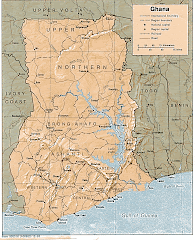
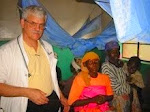
After so long, it seems odd to re-activate this blog. Since leaving Ghana I have been on a number of mission trips. Much has happened at Baptist Medical Center in Nalerigu, as well. Dr Faile, of course, has retired and my good friends Cindy and Paul Shumpert, have been working tirelessly (well, continuously) to find materiel and personnel to continue BMC's mission. Most of you may be aware that the original sponsor for BMC, the Southern Baptist Convention, has been withdrawing support for medical programs for decades. BMC is on its own.
I accepted an assignment here over the holidays to help in a usually thin part of the schedule. As a physician, all holidays are "moveable," of course, none being guaranteed to occur on time or in that idyllic non-time of celebration when the larger world agrees to be held at bay.
This time, however, I will at least be leaving healthy. I hope to stay that way and not become a burden on the resources like I managed to do last time.
The weather I expect will be very similar to what I experienced last time, the dry season. It will be earlier in the season, so I hope that the malnutrition, malaria, and fevers will be less mortal to my marginalized population. Last time, malnutrition clinic, an outdoor affair among the mothers and babies who collect around a government feeding station, was a three times a week intervention of mine to find the kids who were sick enough to be admitted.
I am collecting stuff. Once people know you are going out, you get the emails to take along "a few things" for someone already in the field. My porch has been committed to the collection of piles of books, medical equipment and "stuff." I will need a second bag.
I just published my first novel the end of October, Outland Exile (some of you will get it). You can actually go buy the thing now! If you want a signed copy at substantial discount ($12.95 +S&H) you will need to wait until I return in January, however. http://oldmenandinfidels.com is another blog on writing and the books that I will keep up in the usual dulsatory fashion. I hope to finish book two while I am gone.
Lastly, I covet your prayers for guidance, strength and health. My next entry should be from Ghana.
Friday, November 13, 2015

Sunday, February 17, 2008
Home Again Home Again Jiggity Jig
We (Paul Shumpert and Doug Johnson and I) left Nalerigu at 5:30 AM on Tuesday the 12th last. We drove thru the night to Tamale (TAM-a-lee), dodging donkeys, chickens, goats and cattle who had taken over the road and its residual warmth at night. We arrived at the newly refurbished airport and got through security with little problem. I have failed to mention in these proceedings that the entire backdrop for this mission trip has been the African National Cup games which started a few days after I arrived and continued until the Sunday before I left. Ghana Ghana was in contention for the entire time until a loss to the Cameroons on the 7th February. There was no joy in Mudville, on that occasion. However by now the solace of a 3rd place, consolation victory had turned people’s spirits around from mayhem to “wait 'til next time.” The upside was a number of public work projects, including the Tamale airport.
Our flight to Accra Accra
We are staying n the “Cantonments” section of Accra
We spent exorbitantly to about 35USD for the 3 of us. We then walked from there to the “African Market,” just a couple of blocks from the Gulf of Guinea
Rules for the “Cultural Centre” 1) Don’t stop if someone calls you “Papa,” 2) Don’t stop if someone says “Just look for a second” 3) Never tell anyone what you have to spend. 4) Wear dark-glasses 5) Always hear the sellers price first 6) Act dismayed at the avariousness of mankind and this particular example thereof 7) Quote a price one fourth to a third what was quoted and no more than half what you are willing to spend. 8) Always be willing to walk away unless the price quotes move down in proportion to your moving up 9) the negotiations belong to the guy who cares the least.
I made a few small purchases (an enameled pin and a koooshwa, a rattle) for a few cedi apiece and Paul and Doug made similar small purchases. The cultural center must be taken in small amounts. If you are once identified as a “buyer” people materialize from everywhere to have you see their wares (many of which are quite fine and a goodly number are dreck). We westerners are probably too polite by half and it takes a good deal of time to extricate ourselves.
The rest of the afternoon is spent trying to stay cool and checking our mail. Dinner at the Baptist Guest house is chicken parmesan, the same as I had going out as it happens, the menu is not extensive and it is Tuesday again. I meet and start talking to Andrew who sports the lilting tongue of an Ulsterman from Belfast Ghana Ghana
We sleep like the dead and awake at 5AM to be sure to get to the airport to check in. What we learn today is not good, however. The Monday flight had been cancelled due to a bird strike hitting a jet engine (seagull flambé?) and all those passengers have been carried over into today’s flight. Delta has booked another flight to Atlanta Atlanta
The Atlanta
We finally get on and situated. The flight is about 12 hours long during which I saw some little bit of West Africa, several movies of dubious significance, several meals of indifferent flavor and a good deal of the inside of my eyelids. Our connecting flight is scheduled for 8:30 PM. We do not arrive until about then and still have to go through customs and immigration. We have no hope of making our connecting flight, the last of the night. We go to get our bags only to discover that a large number of bags are waiting to be claimed and a large number of passengers are also waiting for their bags. It appears that most of the JFK bags got on the ATL flight and vice-versa. After a long tine to get our new flight, hotel vouchers and directions. We dash between buildings in short-sleeves (what jacket I did have was in my suitcase) until we can get a shuttle to a local hotel. I spend until 1 AM trying to find a limo home as all previous plans have been scotched by the delays.
I meet Paul for the shuttle the next morning and we check-in with little trouble. Not surprisingly, the flight leaves an hour late, but we are assigned to first class in a Boeing 777. I notice on sitting down that the man next to me has a New Testament and I strike up a conversation with Pastor Rucker of Pickens County Georgia Accra
On arrival we find our bags and Paul sprints off to get his shuttle, Doug has a plane to catch and I still have no way home. After about an hour, I get a one-way rental to Montgomery
I thank all of you for your prayers and concern.
Sunday, February 10, 2008
A Day with Tommy
The hamartan has been over for a week and each day brings a hotter temperature and a more restless night. At 530AM, making virtue of necessity, I get up. Breakfast is black coffee, small local bananas and toast.
I head to the hospital early as I will be spending the day with Tommy. (He will not let me use his full name.) However, I can think there is no one who has come through Nalerigu who does not already know Tommy. He is greeted by shouts of “Tommy!” from passing tractors and by solemn handshakes from village chiefs. Tommy has been in and out of Mamprusi districts for almost 25 years. He “works in the villages” among the 
Compared to other missionaries of my acquaintance, Tommy lives an austere life. He lives in Nalerigu proper (rather than the hospital compound) in a house with a single common room/kitchen, and a small bedroom. He has a Ghanaian cook and a small watchdog, named “dog.” Tommy lives entirely as a Ghanaian. He is bald, tanned to a crisp and well into his 70’s. His speech betrays his small town South origins and he would be at home behind (or underneath) any John Deere known to the hand of
Tommy started coming to
We follow the ridge south through Nagbo where we pick up Rachel, “a faithful.” She has consented to help today. Wednesday, Thursday and Sunday (weather permitting) Tommy sees his small congregations among the villages. Rachel is in her mid-thirties and races over the forecourt of her home in Nagbo, remarkable because she has lost her right leg and is on crutches. We exchange greetings all around (“Dasubah… naaah… naaah”)
“Naah” by the way is one of those essential words one discovers in a language which makes one wonder how other languages get along without it. It has no precise meaning. It is a universal answer to all greetings and most social settings. It is said with affection and gusto and drawn out to a wonderful extent. When I asked one of the boys what it meant as an answer to a greeting he said immediately “It means you have been greeted.” The morning was filled with these brief greetings, as the truck stopped, people piled in or out; “Dasubah (“I greet you in the morning”)…naaah, naaah, naaah.”
We continue down the increasingly dubious road, the ridge becoming lower and less distinct as we travel south, past Tianoba, over the bridge and up to Joanni, and take the right turning to Tunni. Here we are to pick up a preacher for one of the other villages we will go through. However when we arrive we discover that the man’s mother has died that very morning. She will be buried before nightfall and already mourners are walking and pedaling from the countryside to attend. Burial is prompt in this warm country but funerals are usually all held in the dry season when farms are at their slowest, perhaps as much as 6 months after the event. The dry season is also when many of the older members are carried off by chronic disease or malaria.
We greet all the mourners on the road and continue on to Kaliba, a Kokoma village. Like Mamprusi villages, the houses are made of sun-dried brick with conical thatched roofs. Each house is a compound with round rooms for each woman and her young children, a square room for each man and a windowless low room for older children. The entire house is then connected by a smoothly plastered mud-wall giving it a pleasing substantialness. In
We stop in Nakpuliga, at the top of a rise since we see a school in progress. A typically African affair, it consists of a crooked wooden sun-screen and a tired blackboard. Tommy invites me to make the acquaintance of the school teacher. She is a young Ghanaian who seems quite in charge of her three dozen children ranging from 4 or 5 to early teens. All are solemn quiet and well-behaved. “Good Morning, Sir” is said with a deferential bow. All is of the highest decorum until I ask to take a picture. Discipline wilts against the opportunity to see oneself. Giggles, smiles and jostling erupt. A small bag of balloons has found its way to the teacher and discipline is re-established on the simple basis of bribery. The teacher, as I go is anxious to tell me her plans to use the school as the site of a church meeting.
We stop at the next village, Ba’ali, to drop off Rachel. We are greeted with enthusiastic drumming singing and step-dancing to a
Church planting is an irregular affair. Tommy notes that his ground work sometimes takes a decade of well-digging, friend-making, funeral–attendance and showing respect to the chiefs before “overnight” a group of believers is found and regular meetings are held. A major failure has been Nagbo, only a short distance from the hospital. This is primarily because of the attitude of the Muslim families whose children convert; they are locked up, without food or water until they recant. Many are then abandoned if they still refuse, giving up all for their faith. Even so this is preferable to the “honor” killings seen elsewhere under similar situations.
Tommy is extremely short-handed today and what might have been regular services are reduced to greetings and sharing the news of the death. Ba’ali is the destination for Rachel and we arrive to drums and singing under a shade tree. Rachel is introduced and we are off to Bakuli, a
We are off again and reach a large flat area, the floodplain. Near the river we see a large herd of very fine cattle. They are from
Once past the river we stop briefly at Sou, a Gombu village, to greet, share news and pick up a translator. Our final stop is at Tiini, literally “one tree.” That one tree is an impressive baobab, one of the largest species in the world. In the dry season, one can see why it has been described as an “upside-down tree. “ Its thick trunk supports short root-like branches and tiny leaves. We arrive as the celebration is in full swing. The service is held in a shade of the other trees. The congregation of about thirty, dance in a circle and sing the line-response songs so familiar in much of 
We greet the village chief and Tommy heads into the dancing, his translator having had the privilege of carrying Tommy’s Mampruli Bible in the dancing, Tommy has hand free to keep time with his hands. I make a round of picture taking, doing close-ups of the usually somber faced Gombu and then showing them the results on my camera. This immediately gives me huge smiles for the taking (which was my original intent). After several choruses, the dancers sit on wooden benches under the trees and Tommy begins. These are usually practical messages on Christian living. Today’s is on being known “by your fruit.” Tommy is an animated speaker even in translation and he gestures and points at the trees around us in explanation. He asks questions of the audience who respond in severalty and volume. The points are simple and to the point. Afterward I see a few children and we take the road back…rewinding the road as we had unwound it during the morning. The road seemed longer and certainly hotter on the return, probably about 100F but dusty and dry.
The road back was filled with talk of missions and methods. Tommy is very adamant regarding the mode of successful missions; he thinks that a missionary needs to imitate the culture, to live as and with the population. Tommy lives his convictions. Nevertheless, he is very supportive of the role of hospitals for Christian evangelism; medical missions have suffered an eclipse for the last 30 years despite its seminal role in opening many mission fields from Africa to
Tommy’s success also comes with private support; he supports himself and is not affiliated with any mission board. Nevertheless, as we collect and drop off people and produce along the way back to town, I wonder what a 21st century apostle would look like and I keep coming up with an image of Tommy.
Saturday, February 2, 2008
Feeding Babies
Daily I do rounds in Paediatrics, see the small babies in Maternity and then do sick rounds in “Nutrition, a feeding station for outpatient malnutrition patients. Twice a week I see all 3 dozen patients or so for evaluation of their progress.
Feeding stations are a staple of mission hospitals, either free-standing or in cooperation with the government as this one is. Mothers are admitted with all their children for supplemental feedings, lessons on food production and general child health like immunizations, malaria prevention and safe water tasks. One may not notice this at first as these tasks take place under the filtered light of locust trees in an area around an open-air tin-roofed affair. The furnishings are low benches, tables and the concrete floor. Across one wall, hand-drawn pictures illustrate fruits, vegetables and cereals (red millet is the favorite, known locally as “guinea corn”). Murals on the half-walls illustrate a market scene. A fortified room with heavy padlocks houses the supplemental food, sporting “A gift from
The give-away to the feeding station are the mats stretched out among the trees and the scrupulously swept dirt each morning.
Much of this belies the sophistication of the work being done. The subsistence farmers will do well during the wet season but slip into starvation during the “dry.” The diet contracts to merely millet and taro root; both of which tend to make malnutrition worse as they prevent absorption of some nutrients. Children, particularly after they are weaned are at special risk. Children do well until they are introduced to solid foods at about 5-6 months. It is only then that a fat infant starts a cycle of a relatively minor infections, a period of weight loss, a small rise and then another failure. It is not uncommon to see a child lose weight from 5 to 14 months, weighing 12 lbs when identified.
Their diet is “koko” or “tizit,” essentially millet porridge or gruel respectively. Considering that a child then is a greater risk for contracting malaria, typhoid and parasites compared to an adult, it is not hard to imagine such a one “being knocked off the wall” and sliding in to marasmus or kwashiorkor.  The first is total nutritional deprivation with muscle wasting and the look of the aged in the eyes of a 9-month old. A stethoscope cannot find enough tissue between the ribs to make listening easy.
Kwashiorkor is a protein malnutrition with the pot-belly, swollen legs, red hair and pale skin of numerous “poster children” for famine of the last 50 years. These have to be treated with caution as rapid re-feeding is associated with sudden death as malnourished hearts try to accommodate the changes. These children in particular need a “complete” protein. No vegetarian protein source is “complete” for human infants. Each by itself would gradually produce protein deficiency.
The answer is remarkable. The Nutrition station makes its own variety of “koko” (porridge) from millet (very much tastier than maize) and soy beans. The right proportions are coarsely ground in a wooden mortar, retaining the husk of the millet, (which is usually removed my soaking otherwise). The coarse grounds are lightly roasted and and then finely ground to a flour. I exaggerate in no way by saying this stuff is good! It produces a porridge with complementary proteins from the two sources, very much closer to an “complete” protein.
I go over all the weight curves and treat all the acute malarias, pneumonias, typhoids and such of the “well” kids; admit the 4 or 5 who need to be hospitalized for the same problems and admit the 3 or 4 who have finally “failed” in a bid to gain weight. These may die in hospital from their malnutrition. They of course, die of some disease like malaria or meningitis but the bottom line is that they arrived at death’s door merely from starvation, the “intercurrent” disease merely ushers them through.
I frequently hear travelers who come home complaining that the unsophistocated natives of the “third” world imagine that all Americans are rich. Considering never fearing starvation as a measure of immense wealth, I wonder who the naïve one is.
Wednesday, January 30, 2008
Empty Spaces
I was called at 4:15 on Monday morning; the “well” preemie in maternity was having respiratory distress and the midwife had started oxygen. I pulled on same scrubs, strapped on my “fanny pack” filled with my medical tools, a couple of books, a hand-sanitizer, insect repellant and a small camera and walked up the hospital. The ‘hamartan” was blowing briskly, the moon was up and the road was easily visible until it got under the drought-stripped locusts. The drums which I had heard at sun-down continued now; a local chief had died and the “death house” was a scant couple of miles over the next ridge east of here. The creaky-gate call of a solitary fruit bat ticked off one per second. I didn’t bother with my “torch” for the quarter mile walk.
I met and passed a few Ghanaians’ with a polite “najanuri….naaah” formula (good evening…. *acknowledgement*) and crossed over into the maze of concrete steps and ramps which is the sign of a rural hospital in Africa . Electricity is never taken for granted and all areas can be reached by gurney and muscle- power. I turned down to maternity and into the nurses’ station to find my 5 day old patient. He was vigorous and feeding well by cup just this afternoon.
He really did look sick. He was breathing fast, pulling in between the ribs as he did so. His heart tripping along at almost 200 beats a minute. I washed my hands and started to examine him; involuntarily pulling my hand back as I started. He was HOT. The reason became apparent. The ancient incubator had two settings: “Off” and “On”. The nurses, taking counsel of their own discomfort at the cool weather had turned on the heat and left it on. The baby’s temp was 38.5C, about 102.7 or about 5 degrees Fahrenheit higher than it should ever have reached. I had the heat off and the incubator lid opened. Wrote some instructions about measuring the infant’s temperature to determine his care and went to see my other little patient who was on the ward. He looked no worse than he had that evening, warm but having some trouble breathing himself. I adjusted his position, replaced a water bottle and went back to the house.
At 5:15 I was called that my baby on the ward “had stopped breathing.” Something is usually lost in the translation of course, as the messengers are merely ward workers and not nursing staff. I asked if this meant he had died; a blank stare and a shrug was the answer as they turned back into the darkness. I followed them shortly, and arrived ahead of my own orders.
The reality was rather closer than I wanted. He was gasping again, heart rate (again) in the 60’s, pale cold blue and dead looking. I called for the breathing bag (the hospital has one for infants) and started to stimulate him to breathe (a maneuver which is not likely to work without the bag). He gasped and gave a squeaky breathe. Looking more carefully, with my “torch” I could see he was not breathing through his nostrils as they were completely obstructed with dried mucous. I cleared a bit away, got the bag and started to breathe for him. His heart rate once more responded. The next half hour was a modestly disgusting routine of suctioning his small nose of sticky secretions, adding saline drops, and suctioning again. Gradually, his breathing regularized with no squeaky sounds. I gave him some aminophylline to (hopefully) stimulate his respiratory center. By now however, he was again truly cold. The sun had still a half-hour before its debut and we were out of hot water.
Thinking things were at least stable, I went back to “house six” made up some breakfast and recharged the bottles with hot water from the geyser. Walking back, a box of bottles perched on a shoulder, with breakfast in hand, I considered that I had defeated the powers of disease and chaos rather handily. I swung into Paeds with my burden as rounds were starting. His bed was empty, the family gone and a few cold IV bottles surrounded the emptiness. An empty space.
I rechecked on my baby in the incubator. His temperature was normal, all signs of respiratory distress was gone, he was pink and well perfused but not feeding as well as previously. Considering he was most of the way to “well-done” a few hours previously, I was content.
In mid-afternoon a maternity worker brought me a chart. Scribbled at the bottom of the nurses’ notes: “baby stopped breathing. Chaplain called. 1403.” Another empty space. So far all small or sick babies who have been admitted have died.
Friday, January 25, 2008
Hot Water
[Update: UAB med student, Dough Johnson was hit rather heavily by the local gut bug (? Nalerigu Wringer?) and was out of work today. He is mending and may be able to return to work tomorrow. I am mostly over this pneumonia and thank everyone for the prayers, it has made all the difference]
Hot Water: a simple concept of course, you take cold water and apply heat.
The baby was premature at birth 2 weeks ago but had grown and the midwives discharged the infant last Sunday weighing about 5lbs 6 oz with instructions to come back to the hospital (a walking distance away) if anything should happen. By the time “something had happened” on the morning on Wednesday and the parents had worked their way through the long lines and had been seen by a medical assistant and had been identified, had worked through the lab and had gotten to the ward, it was 5PM and we were at the door to leave.
He was small frail, cold, blue and gasping. His heart rate was fast and thready. I examined him and as well as I could tell, he had no pneumonia, abdominal catastrophe, trauma or “localizing sign.” He was just dying. Back home we would probably talk roundly of “late neonatal bacterial sepsis” would get labs as appropriate, would start an aggressive course of fluids, pressors, mechanical ventilators, steroids and antibiotics. He would be tubed and “lined” monitored and measured.
What we had was IV fluids, low flow oxygen and precious little faith. A spinal tap was done quickly, once the IV was “set,” antibiotics were given and I set about to see if we could reverse the inevitable. We pushed in saline to open up his collapsing blood supply but within minutes his faint breathing stopped and his heart rate fell to the sixties.
“We lost him.”
Despite all though, his gasping respirations continued and his heart rate lingered below a hundred. I was discouraged and fascinated; it is a peculiar thing that when an infant is dying, the heart continues to beat faithfully long after death is assured, long after all measures are made and failed and long after the staff are too discouraged and exhausted to notice. Even brief tortured breaths can be noted. So was it here. I gave orders to be called when he died and left at 8PM for a cold dinner of rice and beans. I circled around afterwards to talk with the staff and said how I had appreciated how they worked with the “baby who died.”
“Oh he is not dead yet.”
Humility is not a condition I cultivate but would learn something of it then.
He was still cold and pale but breathing easily with a good heart rate.
He still looked dead to me.
What more was there to do for my embarrassing patient?
“When all else fails, start at the beginning,” I was told once.
Vitals signs were ok now but this temperature? A quick check for the record; his temperature was 32.6C (about 92F); hardly above the room temperature. How were we to warm him? There is no incubator for him; no electronic gismo to make sure the temperature stays even. On the wards there is not even running water. The hospital has hot water, for washing surgical equipment, IV bottles and such, and it closes at night as does the lab.
He needed hot water bottles; a remedy of which my mother would have greatly approved. The pharmacy was at least a place to start. I called to the newly arrived volunteer, Chuck Holmes, and we started to conspire. Half-quart glass IV bottles would be water-proof with no leaking onto the bed, easily transported in cardboard boxes and insulated therein to boot. I acquired my first half-dozen bottles, filled three with hot tap water rather than the scalding distilled water from the still and carted over to paediatics the first batch. We tucked them into folds in the thin cotton “kanga” cloths which serve as bassinet, clothes and diaper for newborns; one on either side and one at the head (heat loss is largely from the head). He still looked dead and it took an exam to prove to me he was breathing and had a heart rate. I circled around, collected my next half-dozen bottles and headed back to “House 6” about a quarter mile away, with a mission.
Hot water in most African mission stations and indeed in most places I have stayed is provided by a “geyser” (pronounced “geezer” at least in central and east
Again surprisingly, our “Lazarus” gained temperature with each hour reaching normal in about 5 hours. Maintaining his temperature during our current hamartan (dust storm) was tricky, all the Ghanaians are complaining bitterly of the cold night weather, going down as it does to the hi 50’s in unheated mud wattle houses. Nevertheless, Lazarus was warm yawning and active by morning. We could even stop the bottles by this evening, as he was well enough to cuddle with mother instead.
We have just started trying to re-feed him by tube now; I have no idea whether it will be successful and what ever damage he might have sustained. I do know that anyone who says that serving is rural
Wednesday, January 23, 2008
Cleft Lip Repair
Cleft Lip Repair
Quiet in a lime green room with piles of instruments wrapped in clean discolored and bleached out packages, stacked in a corner. A tape-player doing Bob Marley covers. A small child naked in the middle of the room on a table, an IV trailing from a small arm. He is apprehensive, wide-eyed and absolutely quiet.
His face is marred by a cleft lip, exposing his teeth and gums. Dr George Faile, almost equally quiet, takes a “before” photo and proceeds to consider his patient. Gentle hands move lip and tissue to imitate his thoughts. Hands cup about an anxious young face, straightening it for the trial. Measurements are made and re-made; after minutes, a pen is produced and the thoughts are committed to ink on skin; hands return to move tissue to what will become new reality. A final check and a small injection into the IV. Lids flutter and close.
A small face is draped with towels; gauze is inserted into the mouth to prevent blood finding a windpipe while the boy sleeps. Suction apparatus is rigged, short quiet sentences and all is ready.
A prayer to the creator God; a request for guidance, mercy and healing for the boy.
Bright red blood against black-skin, white teeth and yellow rubber glove. Hands dance in attendance over the small field of a boy’s face. Decisive cuts, bleeding erupts and is subdued with heat and smoke. The smell of burnt flesh is part of the ritual of healing. Flesh is again measured, approximated and for the moment left open, a wide red gash in a young face. The cycle of drawing together the flesh begins.  Parts long separated are reunited, flesh deficient is augmented by design; odd pattern is revealed as a fitting together of puzzles into a new declaration of wholeness. The red gash narrows; tissue layers are arranged and straightened. Finally the now thin red wound is closed by blue sutures against the black skin of the boy. A final suture is cut. He does not awake as yet but his face is whole.
Tuesday, January 22, 2008
Update
Dear Friends,
I continue to improve and today received a "care-package" of medications from Cindy Shumpert "just in the nick of time." I also had the pleasure of meeting Doug Johnson, UAB School of Med. MSIV, who came with Paul Shumpert MD, arrived today at Nalerigu. Today is a day of arrivals and tomorrow of departures, a Bud Young MD, Megan ( med/peds resident) and Tomas (an Argentinian) all leave for Tamale and Accre in the afternoon.
We had a bit of an outing today, going up to the escarpment with the new arrivals, a walk and a climb through this dry land, to a cliff face overseeing the dusty river bed with a thin line of verdant at the bottom.
Tomorrow I am scheduled to see all the nutrition patients. Joanna, the nutrition nurse and I are actively plotting how we will improve things while I am here. Over the weekend, we lost another baby; probably due to gastric rupture from prolonged labor. There is much to do.
BTW, some ppeople were having problems leaving comments. This should be solved as of now.
I continue to improve and today received a "care-package" of medications from Cindy Shumpert "just in the nick of time." I also had the pleasure of meeting Doug Johnson, UAB School of Med. MSIV, who came with Paul Shumpert MD, arrived today at Nalerigu. Today is a day of arrivals and tomorrow of departures, a Bud Young MD, Megan ( med/peds resident) and Tomas (an Argentinian) all leave for Tamale and Accre in the afternoon.
We had a bit of an outing today, going up to the escarpment with the new arrivals, a walk and a climb through this dry land, to a cliff face overseeing the dusty river bed with a thin line of verdant at the bottom.
Tomorrow I am scheduled to see all the nutrition patients. Joanna, the nutrition nurse and I are actively plotting how we will improve things while I am here. Over the weekend, we lost another baby; probably due to gastric rupture from prolonged labor. There is much to do.
BTW, some ppeople were having problems leaving comments. This should be solved as of now.
Sunday, January 20, 2008
Work Permit
George Faile left me just now with a “work permit” to return to the hospital, an admonition to not get over-worked and a few days more treatment. I am no longer coughing as badly although I still have “a few crackles” on my left chest.
Let me first thank you all for your prayers and our God for his mercies. I am not well but I am better. I work from one treatment to the next and sleep well.
Choirs perform with gusto and volume; music provided by an over worked sound-system, an indifferently tuned piano, a drum set, tambourines, and an electric organ. The wind is blowing up another “hamartan” and the fans overhead are not running. Children wander in an out, are tracked-down, captured and kept hostage or escorted out by mothers, older sisters or “aunts,” babies asleep on their mothers’ backs, oblivious to the commotion.
Offerings are provided for with a whole church “march” for want of a better name. Everyone comes to the front to deposit their gifts in a box. However, the joy expressed is nothing regimented. Grandmas shuffle along shooing children from under un-steady feet, girls dance up and back, hardly touching down; matrons demonstrate dance steps I would have coveted in a previous life. All is joy and hub-bub. The service is in English and Mampuli, the local language. The sermon was on “building good relationships” Romans 12: 9-21. It was a nine-point sermon, in English; I saw many people taking notes.
I was the only volunteer attending; there were three gun-shot wounds, 3 stat cesareans (one mother who coded on the table), an acute abdomen laparotomy over-night and a morning of ultra-sounds to do. Everyone had slept in, woken, rushed out and was already back at work when I was collected. And I have a work-permit starting tomorrow.
Saturday, January 19, 2008
Update
Thank you first for your concerns and prayers.
I am better, I think. The fever is down, the cough is much better and I can sleep for hours.
I am still under immediate threat of being kicked out unless I get a LOT better by tomorrow so....don't stop.
I am better, I think. The fever is down, the cough is much better and I can sleep for hours.
I am still under immediate threat of being kicked out unless I get a LOT better by tomorrow so....don't stop.
Subscribe to:
Comments (Atom)